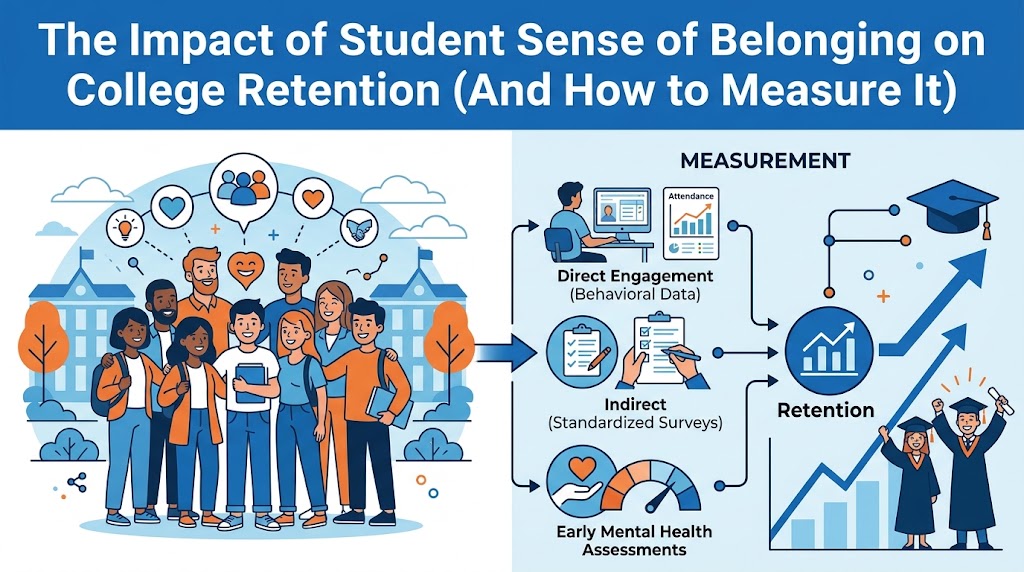
A strong sense of belonging is having a major moment in higher education, and for good reason. While the feeling that you belong has always been crucial in personal relationships and work, researchers emphasize that defining and measuring it in educational settings remains elusive.
Understanding how students find their place—especially leading up to and during their first college experience—is critical for boosting student retention and enrollment success.
Why a Sense of Belonging Matters for Student Success
Social connection is vitally important for mental health. In fact, Psychology Today (2025) reports that it is one of the “single strongest contributors to one’s happiness and well-being”. Isolation and depression—feelings counter to belonging—can begin as early as elementary school. Research shows that children with high levels of belonging see themselves as important and likable, which drives their willingness to participate. The confidence that belonging brings also builds social capital, influencing how others perceive them.
However, research demonstrates that specific student subgroups are at a higher risk for non-enrollment and dropping out because they may not believe they belong. When historically under-served students, first-generation students, and students with intersectional identities (such as race, ethnicity, age, religion, socioeconomic status, or sexual orientation) face discomfort and isolation, the potential to impede their success is much higher—especially when compounded by financial stress.
As Dias-Broens et al. note, “students’ sense of belonging was found to be positively related to emotional wellbeing, academic motivation and success in higher education”.
The Challenge of Measuring Student Belonging
If we understand its relationship to college persistence, why is measuring a student’s sense of belonging so difficult? Here are the primary hurdles:
- Unique Campus Factors: Sense of belonging cannot be studied in isolation. Like all social science research, it is influenced by a unique set of variables specific to each individual campus.
- Subjectivity in Self-Reported Data: Most analyses rely on self-reported data. While this yields important qualitative information, it depends heavily on students understanding the survey questions and accurately assessing their own feelings of acceptance. Administering emotional intelligence assessments in First-Year Experience (FYE) classes reveals that answering from the viewpoint of who you truly are versus who you want others to think you are is incredibly difficult for new college students.
- Declining Survey Response Rates: It is becoming harder to convince students to share their private thoughts, a phenomenon directly correlated to the engagement we are trying to measure. According to the National Survey of Student Engagement (NSSE), response rates have plummeted from 38% in 2010 to just 23% in 2024. Similar declines have been observed in institutional effectiveness offices, with the Ruffalo Noel Levitz Student Satisfaction Inventory (SSI) hitting a new low of under 30%.
A Mixed-Methodology Approach to Measuring Campus Engagement
So, what can enrollment managers and higher education administrators do to measure this vital influence on persistence and retention? The most effective option is to use a mixed-methodology approach:
1. Direct Measures of Engagement
Track behavioral data to see how students are interacting with the campus ecosystem. Key metrics include:
- Attendance in physical and virtual classroom environments.
- Academic participation (e.g., LMS discussion boards and classroom discussions).
- Facility usage, including tutoring centers, libraries, and dining halls.
- Time to first enrollment and re-enrollment rates.
- Event engagement, such as athletics, fine arts, and student clubs or organizations.
2. Indirect Measures and Standardized Surveys
Use established national surveys to provide insights on engagement and performance gaps. Valuable tools include:
- Student Satisfaction Surveys from Ruffalo Noel Levitz
3. Early Mental Health Assessments
Mental health surveys are highly useful tools to determine if a significant proportion of first-time students feel isolated. Administering these surveys early—ideally during the first 8 weeks of the fall semester—provides a critical window for intervention before a student decides to drop out mid-year.
Ultimately, measuring belonging is only step one; the most important thing is to take action using the data you have.
Are you measuring sense of belonging in relation to persistence and retention? Datatelligent can support your efforts to improve retention through mixed methods research with data integration in a secure cloud-space for traditional analytics and AI. Ask about our Fusion platform today!
References & Further Reading
- Bono, T. (2025, February 26). Sense of Belonging in College: Hard to Find, Hard to Measure. Psychology Today.
- Dias-Broens, A. S., Meeuwisse, M., & Severiens, S. E. (2024). The definition and measurement of sense of belonging in higher education: A systematic literature review with a special focus on students’ ethnicity and generation status in higher education. Educational Research Review, 45.
- The Chronicle of Higher Education. (2026). Read about Dr. John B. King, Jr.’s focus as the Chancellor of the State University of New York in The Chancellor of Belonging, featured in People to Watch 2026.
- Lam, V.W.H., & Webb, C. (2026). Graduate Student Center: An Increased Sense of Belonging for Graduate and Professional. New Directions for Higher Education.
- Stickl Haugen, J., Frawley, C., & Bledsoe, K. G. (2025). The Development of the Student Belonging Scale: A Measure of School Belonging. Professional School Counseling, 9, 1-12.
- Vincente, S., & Matusovich, H. (2026). Sense of Belonging and Intent to Return in a STEM Internship Program. New Directions for Higher Education.