Try Our FREE IPEDS Comparison Tool!

Categories
Blog

Elevating the Full Student Success Lifecycle: A Holistic Data Strategy 

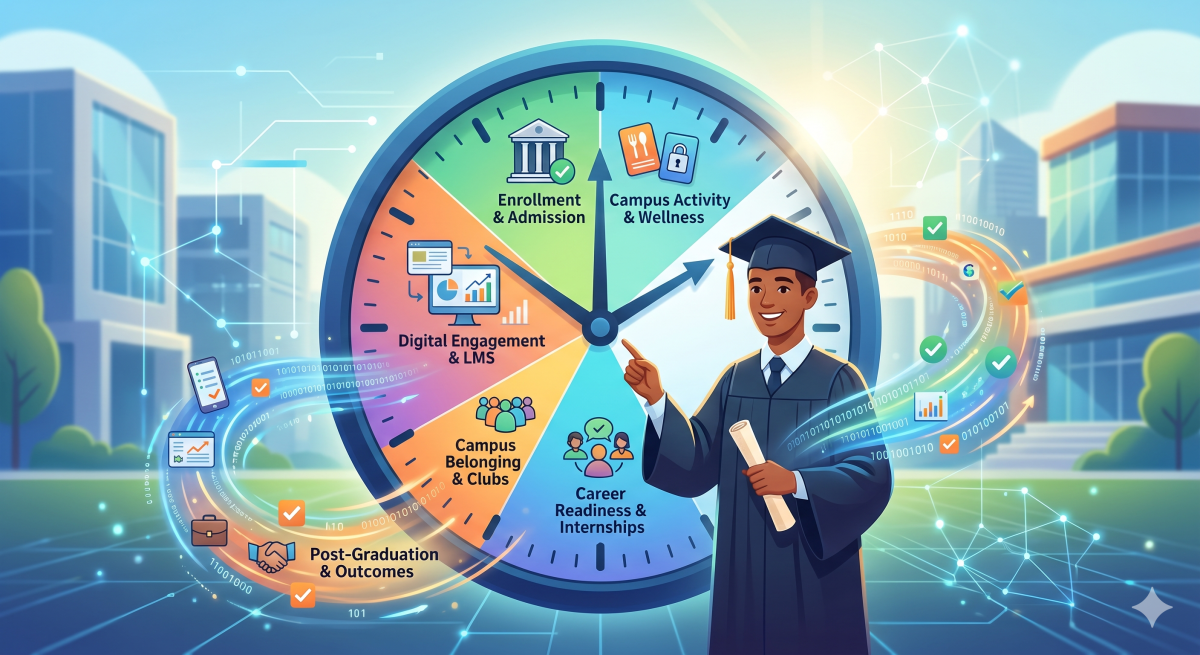
Higher education has traditionally measured student success through a narrow lens of GPAs, credit hours, and graduation rates. However, modern institutions recognize that a student’s journey is far more complex, encompassing their physical environment, mental well-being, campus engagement, and eventual career readiness. To truly support students from their first day on campus to their transition into the workforce, institutions must look beyond traditional academic metrics and embrace a holistic, campus-wide data strategy. 

The Foundation: Enrollment, Aid, and Retention 

While expanding our view of the student lifecycle is critical, it must be built on a solid baseline of institutional health. The foundational triad of enrollment strategies, financial aid distribution, and retention rates dictates much of an institution’s operational capability. Connecting these core systems helps uncover which student populations might be financially vulnerable long before they decide to leave. 

For a comprehensive breakdown of how bringing these specific financial and demographic metrics together can reveal the true ROI of your institutional investments, check out our recent post on Linking Enrollment, Aid, and Retention. Once that baseline is established, campus leaders can shift their focus to the daily behavioral signals that define the broader student experience. 

Proactive Wellness Checks: Safeguarding Through Campus Activity 

One of the most vital, yet complex, areas of the student lifecycle is physical and mental well-being. Often, when a student begins to struggle, the first signs aren’t academic—they are behavioral. By thoughtfully leveraging campus infrastructure data, institutions can facilitate proactive wellness checks to support their student body. 

This involves monitoring subtle, campus-wide shifts, such as a sudden cessation of dining hall meal swipes or a prolonged absence of residence hall badge-ins. A sudden change in these daily routines can serve as a gentle early-warning signal that a student is isolating themselves or experiencing distress. 

The absolute most critical component of this strategy is data privacy and ethical stewardship. This behavioral data must be securely managed—kept strictly private and anonymized within the institution’s architecture. It should only ever be de-anonymized and accessed when absolutely necessary to trigger a secure alert to specialized student life professionals or counselors who can step in to offer targeted support. 

Digital Engagement: Navigating the LMS Landscape 

A student’s digital footprint provides real-time insights into their academic momentum. Moving beyond simple midterm grades, institutions can analyze Learning Management System (LMS) engagement to gauge academic health. Metrics such as login frequency, time spent reviewing course materials, and participation in discussion boards can identify students who might be quietly falling behind. When these digital engagement metrics are synthesized with advising records, faculty can intervene weeks before a struggling student fails a major assignment, offering tutoring or academic coaching exactly when it will make the most impact. 

Extracurricular Connection: The Belonging Metric 

Students who feel a sense of belonging on campus are overwhelmingly more likely to succeed. Tracking participation in intramural sports, registered student organizations, and Greek life can help institutions measure this elusive “belonging” metric. If data shows that a specific cohort of first-year students hasn’t engaged with any campus organizations by week six, student affairs teams can launch targeted outreach campaigns, inviting them to specific events or clubs that align with their initial intake interests. 

Career Readiness: The Post-Graduation Transition 

The final stage of the student success lifecycle isn’t graduation—it’s the successful transition into the professional world. Modern student success tracking should encompass career center engagement, internship placement rates, and alumni networking activities. By analyzing which campus organizations, resume workshops, or early-career interventions yield the highest post-graduation placement rates, institutions can continuously refine their programming to better align with actual workforce outcomes. 

Unifying the Lifecycle with The Fusion Platform 

The greatest barrier to mapping this complete lifecycle isn’t a lack of data—it’s the presence of departmental silos. Student affairs, academic advising, and the career center often operate on entirely different, disconnected software systems. 

To bridge these gaps, institutions require an advanced institutional data lake capable of handling complex, multi-source inputs. By leveraging The Fusion Platform, universities can securely aggregate SIS records, LMS activity, and campus infrastructure data into one cohesive environment. This centralized approach empowers campus leaders with AI-driven insights, turning fragmented daily interactions into a comprehensive, actionable view of student well-being and success. 

Advancing data advocacy in higher education requires ongoing conversation, ethical boundaries, and technological commitment. For more ongoing discussions on how institutional intelligence is transforming the student experience, tune into the Data Stakes podcast, where the conversation continues on how to make campus data work for the students it represents. 
Categories
Blog

Demystifying the AI Data Lake: A Guide to Generative AI Data Lake Implementation 

For years, organizations have been focused on simply collecting and storing as much information as possible. The traditional data lake served this purpose well, acting as a massive repository for raw, unstructured data. However, the landscape has shifted. Today, it is no longer enough to merely hoard data; organizations must be able to actively converse with it. We are moving from passive storage toward intelligent, interactive ecosystems, making the leap from traditional data management to dynamic, AI-driven environments. 

What is an AI Data Lake? 

An ai data lake represents the next vital evolution in enterprise data architecture. While a standard data lake holds vast amounts of structured, semi-structured, and unstructured data in its native format, it often requires heavy manual intervention—wrangling, cleaning, and structuring—before that data can be useful. 

In contrast, an ai data lake is specifically architected from the ground up to support, train, and deploy artificial intelligence and machine learning models. It includes built-in, automated data preparation, intelligent metadata tagging, and unified governance. This foundational architecture ensures that AI algorithms can seamlessly access, interpret, and learn from the data without the bottleneck of extensive manual engineering. 

The Shift to Generative AI Data Lake Implementation 

Understanding the foundation is just the first step. The true breakthrough comes with generative ai data lake implementation. This process involves integrating Large Language Models (LLMs) and generative AI frameworks directly into the data lake architecture. 

Why is this shift so critical? Historically, extracting insights required data scientists to write complex SQL queries or build custom dashboards. A successful generative ai data lake implementation flips this paradigm. It allows users across an entire organization to use natural language to query, summarize, and generate novel insights directly from the raw data pool. It transforms a static repository of historical facts into a dynamic, conversational knowledge base that can answer complex questions in real time. 

Core Components of a Successful Implementation 

To make this conversational capability a reality, a few key technical components must be in place: 

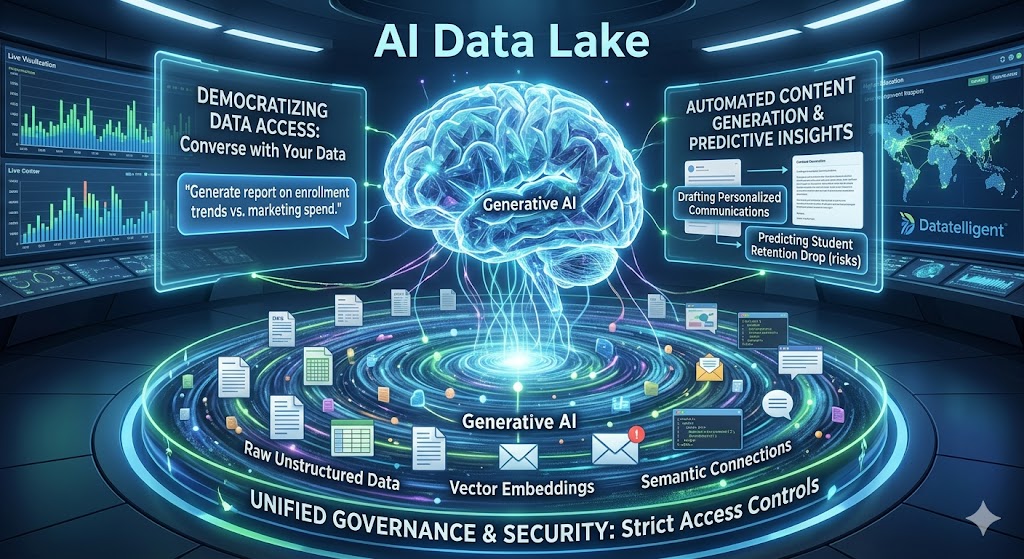
  • Vector Databases & Embeddings: Generative models need to understand context, not just keywords. By converting text and data into vector embeddings, the system can understand the semantic relationship between different pieces of information across the entire lake. 
  • Data Governance & Security: With powerful search and generation capabilities, strict access controls are non-negotiable. A robust implementation ensures that generative AI only surfaces data that a specific user is authorized to view, maintaining compliance and data privacy. 

End Use Cases and Strategic Goals 

Organizations undertaking this implementation are driving toward several transformative goals: 

  • Democratizing Data Access: The primary goal of an ai data lake is to allow non-technical stakeholders to interact with complex datasets. For example, a marketing or admissions director could ask their internal AI, “Generate a report on enrollment trends over the last five years compared to our marketing spend,” and receive a comprehensive, ready-to-publish analysis in seconds. 
  • Automated Content & Report Generation: Instead of starting from scratch, teams can use the generative capabilities to automatically draft personalized communications, generate financial summaries, or even write predictive grant proposals based on historical institutional data. 
  • Advanced Predictive Insights: By feeding unstructured data—such as student feedback forms, emails, and forum posts—into the generative AI, organizations can identify patterns and predict risks, such as student retention drops, long before they become critical issues. 

How Datatelligent Empowers Higher Education 

In higher education, data is often trapped in restrictive silos. Student Information Systems (SIS), Learning Management Systems (LMS), and financial records rarely speak to one another natively, holding institutions back from seeing the complete picture of their campus ecosystem. 

Datatelligent steps in to solve this exact problem by designing and deploying custom data architectures tailored specifically for the unique needs of colleges and universities. By helping institutions execute a generative ai data lake implementation, Datatelligent breaks down these traditional silos. This allows universities to leverage generative AI to boost student success rates, optimize campus operations, and drive targeted enrollment strategies. 

By building secure, scalable, and intelligent data environments that drive true academic and operational innovation, it is easy to see why people see Datatelligent as a university research partner

Categories
Blog

Linking Enrollment, Aid, and Retention: What a Full Picture of Your Student Success Investments Actually Reveals

Higher education has always been in the business of student success. What it has struggled with is knowing, in real terms, what that success actually costs and whether the investments being made are working.

That question has never been more urgent. According to Inside Higher Ed’s 2025 survey, only 28% of Chief Business Officers are highly confident in their institution’s business model. At the same time, affordability remains students’ top concern, and Chief Academic Officers are sounding the alarm about the future of financial aid amid ongoing federal and state funding uncertainty.

Institutions are being asked to do more for students with less certainty about the availability of resources. That is a difficult position to be in, and it becomes nearly impossible when the data needed to make smart decisions is fragmented across systems that don’t talk to each other.

The Silo Problem Nobody Talks About Directly

Ask most institutions whether they track enrollment, financial aid, and retention data, and the answer will almost universally be yes. Ask whether those data sets live in a single, connected view that leaders can act on, and the answer changes quickly.

Enrollment data lives in the SIS. Aid data lives in financial systems. Retention and student success metrics live somewhere else entirely, often managed by a separate team with a separate toolset. Each system is doing its job. The problem is that none of them are talking to each other in a way that surfaces the full picture.

The result is a common and costly gap: institutions are investing in student success without a clear line of sight into which investments are actually moving the needle. Retention initiatives get funded. Aid packages get awarded. Enrollment targets get set. But whether those efforts are connecting, whether a student who received a targeted aid package was more likely to persist, for example, often goes unmeasured simply because the data required to answer that question spans systems that were never designed to work together.

What the Full Picture Actually Reveals

When enrollment, aid, and retention data are unified into a single view, something important happens: patterns that were invisible become actionable. Institutions can begin to see which student populations are most financially vulnerable and most at risk of stopping out, before it happens. They can identify whether aid awards are reaching the students who need them most, or whether gaps exist that are quietly driving attrition. They can connect the dots between enrollment trends, aid utilization, and persistence rates to inform both immediate interventions and longer-term strategies.

This is the difference between spending on student success and investing in it. Spending happens when resources are allocated based on assumptions and historical patterns. Investing happens when decisions are driven by current, connected data that shows what is actually working.

The Cost of Not Connecting the Dots

There is a tendency in higher education to think of data integration as a technology problem, something the IT team will eventually get to. But the real cost is strategic, not technical.

When finance and student success operate from disconnected data, budget conversations happen in a vacuum. Aid decisions are made without full visibility into their downstream impact on retention. Enrollment projections don’t account for the students most likely to leave. And when leadership asks whether the institution’s student success investments are paying off, the honest answer is often: we think so, but we can’t clearly show you.

In an environment where only 28% of CFOs feel confident in their business model, and funding uncertainty is the norm, “we think so” is not a sufficient answer. Boards want evidence. Accreditors want outcomes. Students and families want to know their investment is worth it.

From Siloed Metrics to Strategic Clarity

Connecting enrollment, aid, and retention data isn’t about adding more reports to an already crowded dashboard environment. It’s about replacing disconnected snapshots with a coherent institutional narrative, one that lets leaders ask better questions and get answers while there is still time to act on them.

That means knowing which students are at financial risk right now, not at the end of the term. It means understanding whether current aid strategies are supporting persistence or just reducing short-term attrition. It means being able to walk into a budget conversation with data that connects investment to outcome, rather than defending spending based on intuition.

For institutions navigating the current funding environment, that kind of clarity isn’t a luxury. It’s a strategic necessity.

At Datatelligent, the Fusion Platform is built to do exactly this, bringing together the data that institutions already have across their key systems and making it visible, connected, and actionable in a single environment. When enrollment, aid, and student success data work together, institutions gain a clearer, more complete picture of student success in higher education and stop guessing about what their investments are producing. They start knowing.

And in times like these, knowing makes all the difference.

Latest News
Days
Hours
Minutes