We have all been in that executive meeting. The Provost presents one set of enrollment figures, the Admissions Director presents another, and Finance brings a completely different projection. The next hour isn’t spent making strategic decisions — it’s spent dissecting spreadsheets.
This July, we are focusing on a critical theme: Creating a Single Source of Truth. But to get there, we first have to answer the core question: Why do leaders still argue over whose numbers are right?
Here is a breakdown of what a single source of truth actually looks like in practice, and how to transition your institution from data chaos to clarity.
The Core Issue: “We Don’t Trust Our Own Numbers”
In our recent Office Hours sessions, the most common frustration we hear from institutional leaders is simple: “We don’t trust our own numbers.”
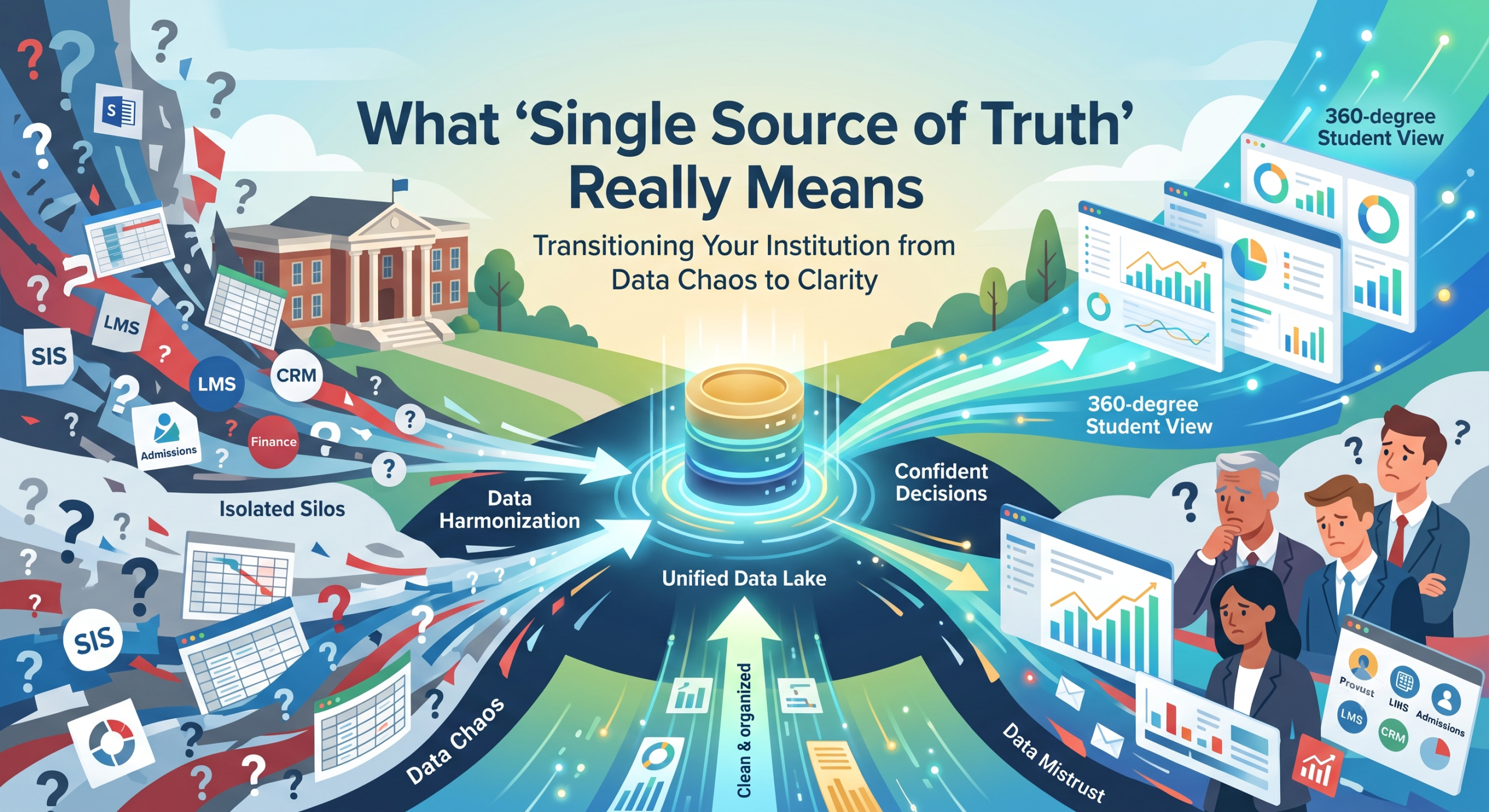
When data lives in isolated silos, different departments naturally develop their own definitions of success. Admissions pulls a report on a Tuesday, Student Affairs pulls one on a Thursday, and because the systems don’t communicate in real-time, the data doesn’t match. This lack of trust leads to decision paralysis. Leaders end up relying on gut feelings rather than data because verifying the numbers takes too much time and energy.
A true single source of truth eliminates this friction. It means everyone in the organization — from the President’s cabinet to department chairs — is looking at the exact same, up-to-date data set, defined by the exact same metrics.
The Solution: Harmonizing SIS, LMS, and CRM Data
You cannot create a single source of truth without bringing your disparate systems together. In our upcoming Micro-webinar, we will be doing a deep dive into Harmonizing SIS, LMS, and CRM Data.
When your Student Information System (SIS), Learning Management System (LMS), and Customer Relationship Management (CRM) tools are disconnected, you only get fragmented views of the student lifecycle. Harmonization is the process of extracting that raw data, cleaning it, standardizing it, and weaving it together into a comprehensive, 360-degree view.
To achieve this at scale, institutions need the right infrastructure.
The Foundation: A Unified Data Lake
The cornerstone of this harmonization is the Data Lake. Unlike traditional, rigid databases, a secure, scalable Data Lake acts as the central hub where all institutional data comes together. Data from your campus systems flows seamlessly into this repository in its raw format. It breaks down departmental silos, ensuring that whether you are analyzing financial aid metrics or student engagement, you are pulling from a unified environment.
The Catalyst: Preset Models
Simply dumping data into a lake isn’t enough; it has to be organized to make sense for higher education. That is where preset models change the game. By utilizing data models that already define the relationships between higher ed data points (like tying a specific enrollment status to a financial aid tier), the heavy lifting is done for you. Our Fusion Platform leverages these preset models so that AI tools and dashboards can instantly and accurately interpret the data without requiring your IT team to build queries from scratch.
The Ultimate Outcome: Fewer Conflicting Reports, More Confident Decisions
As detailed in our latest Outcome brief, the goal of centralizing your data isn’t just better technology — it is operational transformation.
The true value of a single source of truth is summarized by our core outcome: Fewer conflicting reports, more confident decisions. When your leadership team stops arguing over whose spreadsheet is accurate, you reclaim hours of valuable time. You can move past data validation and step directly into strategy, identifying at-risk students sooner, optimizing resource allocation, and driving institutional success with absolute confidence.