Try Our FREE IPEDS Comparison Tool!

Categories
Uncategorized

Moving from Data to Decisions: Inside Our Latest AI in Higher Ed Webinar Author: Larry Blackburn, CEO of Datatelligent

If you work in higher education, you are already intimately familiar with the pressures of the current landscape. Declining enrollments, the need for financial sustainability, student retention hurdles, and increased demands for operational efficiency are squeezing institutional resources across the board. 

Recently, I had the pleasure of sitting down with our Director of Higher Education Growth, Debbie Phelps, to host a webinar on tackling these exact challenges: AI-Powered Analytics: Accelerating Outcomes with Institutional Intelligence

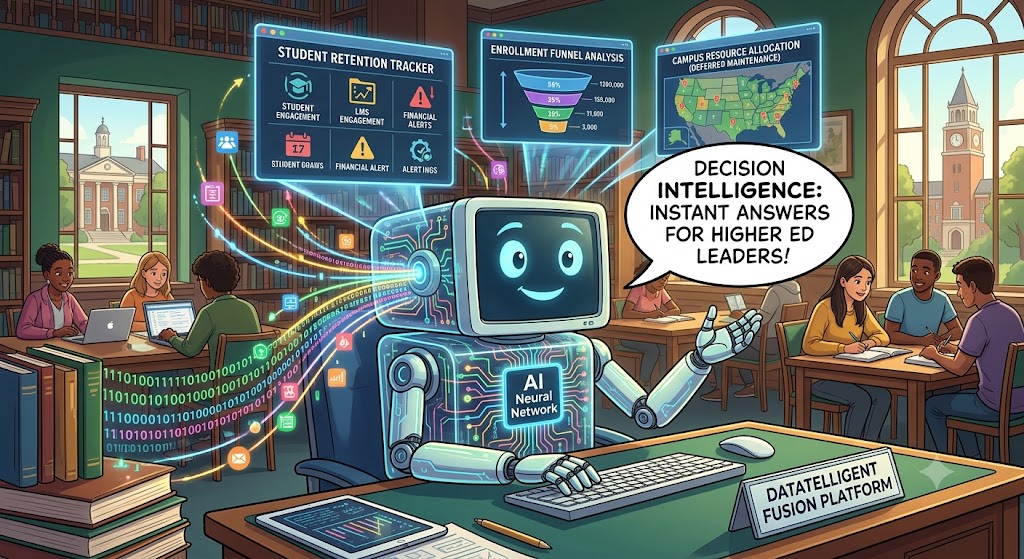
Our core thesis for the event was simple but transformative: The main hurdle in higher ed isn’t a lack of data. Most institutions have plenty of data. The real roadblock is the time it takes to turn that data into answers. By fusing Artificial Intelligence (AI) with Business Intelligence (BI), we can create true decision intelligence—empowering leaders to get conversational answers to their questions exactly when they need them, without waiting on a multi-step reporting queue. 

What We Learned About Higher Ed Using AI 

Throughout the session, we looked at real-world use cases to see exactly how AI is changing the game for colleges and universities. Here are a few key takeaways about how higher ed can actively utilize this technology right now: 

  • Smarter Enrollment Management: AI doesn’t just tell you your headcount is up or down; it tells you why and what to do next. We demonstrated how AI can identify specific bottlenecks in the admissions funnel (such as a drop-off between the applicant and admitted stages) and instantly recommend actions, like prioritizing targeted outreach to keep the funnel moving. 
  • Proactive Student Retention: Predicting dropout risk shouldn’t rely solely on academic capability—it requires identifying structural roadblocks. By analyzing variables like LMS engagement, financial holds, and even a student’s commute distance to campus, AI can bucket students into risk categories. More importantly, it surfaces immediate interventions—like pairing medium-risk students with successful peers or prioritizing TRIO support services—before it’s too late. 
  • Context is Everything: Out-of-the-box AI will fail (and hallucinate) if it doesn’t understand your institution. We discussed the critical importance of Context Engineering—the process of teaching the AI your specific business rules, hierarchies, and metric definitions so that it becomes a reliable, trusted asset. 
  • Operational Efficiency: Beyond the student life cycle, AI is proving invaluable for the business side of higher ed. By combining academic schedules, foot traffic, and inventory data, institutions can proactively manage deferred maintenance and ensure they are allocating resources equitably across all campus locations. 

How Datatelligent Can Help Your Institution 

We know that seeing the potential of AI and actually implementing it on your campus are two very different things. At Datatelligent, we want to meet you wherever you are on your maturity curve. 

If your institution is just starting to explore these concepts, we offer a simple AI for Analytics workshop that we can run with any higher ed team. This is a great way to align your staff, separate the hype from the reality, and understand exactly how AI for Analytics can be securely applied to your specific operational challenges. 

For institutions ready to take the next step, we’ve introduced our Fusion Platform. Built on a secure data cloud foundation, the Fusion platform integrates directly with your existing data to provide a functional, natural-language chatbot experience. Instead of digging through endless dashboards, your leaders can simply type conversational questions into the Fusion chatbot to instantly find valuable data, track strategic KPIs, and uncover the root causes behind your metrics. It’s exactly what it sounds like: a seamless fusion of AI and BI that accelerates your institutional outcomes. 

I encourage you to watch the full webinar above to see these tools in action. If you’re ready to start turning your institutional data into instant decisions, our team is here to help you take that next step. 
Categories
Blog

What ‘Single Source of Truth’ Really Means 

We have all been in that executive meeting. The Provost presents one set of enrollment figures, the Admissions Director presents another, and Finance brings a completely different projection. The next hour isn’t spent making strategic decisions — it’s spent dissecting spreadsheets. 

This July, we are focusing on a critical theme: Creating a Single Source of Truth. But to get there, we first have to answer the core question: Why do leaders still argue over whose numbers are right? 

Here is a breakdown of what a single source of truth actually looks like in practice, and how to transition your institution from data chaos to clarity. 

The Core Issue: “We Don’t Trust Our Own Numbers” 

In our recent Office Hours sessions, the most common frustration we hear from institutional leaders is simple: “We don’t trust our own numbers.” 

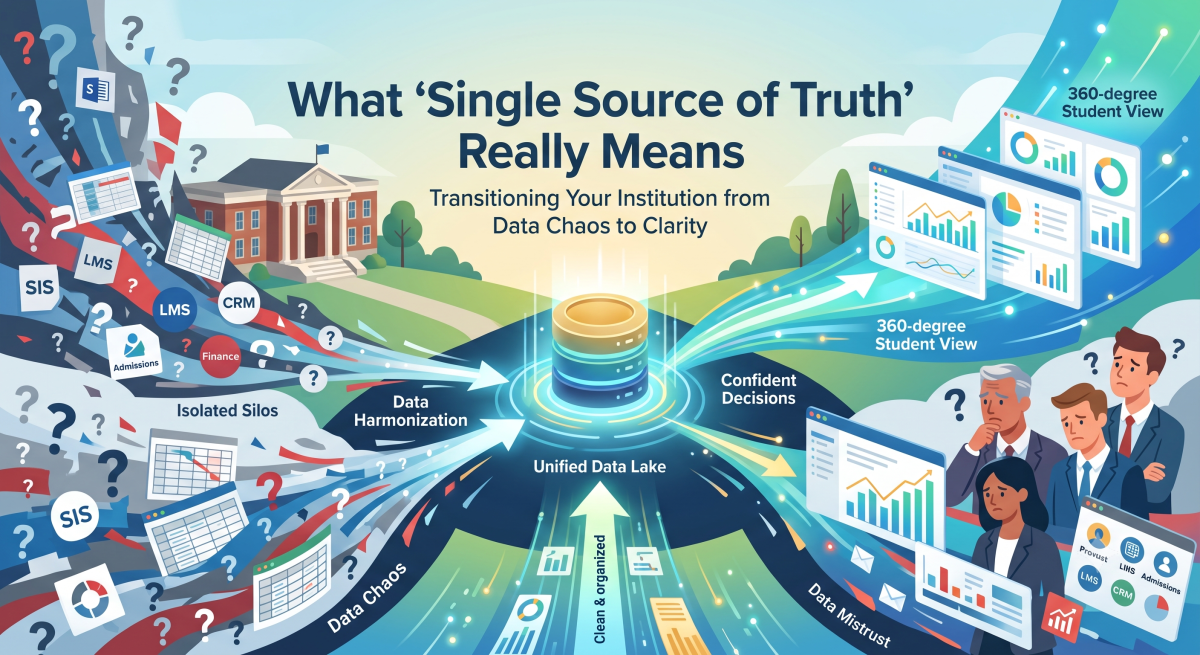
When data lives in isolated silos, different departments naturally develop their own definitions of success. Admissions pulls a report on a Tuesday, Student Affairs pulls one on a Thursday, and because the systems don’t communicate in real-time, the data doesn’t match. This lack of trust leads to decision paralysis. Leaders end up relying on gut feelings rather than data because verifying the numbers takes too much time and energy. 

A true single source of truth eliminates this friction. It means everyone in the organization — from the President’s cabinet to department chairs — is looking at the exact same, up-to-date data set, defined by the exact same metrics.  

The Solution: Harmonizing SIS, LMS, and CRM Data 

You cannot create a single source of truth without bringing your disparate systems together. In our upcoming Micro-webinar, we will be doing a deep dive into Harmonizing SIS, LMS, and CRM Data

When your Student Information System (SIS), Learning Management System (LMS), and Customer Relationship Management (CRM) tools are disconnected, you only get fragmented views of the student lifecycle. Harmonization is the process of extracting that raw data, cleaning it, standardizing it, and weaving it together into a comprehensive, 360-degree view.  

To achieve this at scale, institutions need the right infrastructure. 

The Foundation: A Unified Data Lake 

The cornerstone of this harmonization is the Data Lake. Unlike traditional, rigid databases, a secure, scalable Data Lake acts as the central hub where all institutional data comes together. Data from your campus systems flows seamlessly into this repository in its raw format. It breaks down departmental silos, ensuring that whether you are analyzing financial aid metrics or student engagement, you are pulling from a unified environment.  

The Catalyst: Preset Models 

Simply dumping data into a lake isn’t enough; it has to be organized to make sense for higher education. That is where preset models change the game. By utilizing data models that already define the relationships between higher ed data points (like tying a specific enrollment status to a financial aid tier), the heavy lifting is done for you. Our Fusion Platform leverages these preset models so that AI tools and dashboards can instantly and accurately interpret the data without requiring your IT team to build queries from scratch.  

The Ultimate Outcome: Fewer Conflicting Reports, More Confident Decisions 

As detailed in our latest Outcome brief, the goal of centralizing your data isn’t just better technology — it is operational transformation. 

The true value of a single source of truth is summarized by our core outcome: Fewer conflicting reports, more confident decisions. When your leadership team stops arguing over whose spreadsheet is accurate, you reclaim hours of valuable time. You can move past data validation and step directly into strategy, identifying at-risk students sooner, optimizing resource allocation, and driving institutional success with absolute confidence. 

Latest News
Days
Hours
Minutes