Try Our FREE IPEDS Comparison Tool!

Categories
Blog

Why Static Reports Fail in Volatile Times: The Case for Agile Data in HigherEducation

Higher education has never been short on data. What it has often been short on is the ability to use that data at the speed decisions actually need to be made.

That gap has never been more costly than it is right now. According to Inside Higher Ed’s 2025 survey findings, 50% of Chief Academic Officers report spending more of their time reacting to problems than planning for the future. Meanwhile, 82% of CFOs who expect their institution’s financial health to worsen point directly to uncertainty driven by federal policy and funding as the cause.

The challenge isn’t a lack of awareness. Leaders know what they need to know. The problem is that by the time the data arrives, the moment for action has often already passed.

The Static Report Trap

Most institutions still rely on reporting cycles built for a more predictable world: monthly enrollment snapshots, quarterly budget reviews, annual outcomes reports. These tools made sense when conditions were relatively stable, and decisions could wait.

That world no longer exists.

When federal funding shifts without warning, when enrollment trends break from projections mid-term, when a new state policy lands in the middle of budget planning, institutions need answers now, not at the end of the reporting cycle. Static reports weren’t designed for that kind of pressure. They describe what happened. They don’t help leaders respond to what’s happening.

The result is a familiar and frustrating pattern: by the time leadership has the data they need to act, the decision window has already narrowed or closed entirely.

What “Agile Data” Actually Means

Agile data isn’t a buzzword. It’s a practical shift in how institutions think about information and when it’s available.

An agile data environment is one where:

  • Data is unified across systems, so enrollment, finance, and student success aren’t living in separate silos that have to be manually reconciled before anyone can answer a question.
  • Dashboards reflect near-real-time conditions, not last month’s snapshot.
  • Leaders can stress-test scenarios against actual institutional data, rather than relying on projections built from incomplete or stale inputs.
  • Follow-up questions don’t trigger another round of data preparation. The infrastructure is already in place to answer them.

The difference between a reactive institution and a proactive one often comes down to whether the data is ready when the question is asked.

From Reporting Cycles to Real-Time Strategy

Consider a common scenario: enrollment numbers begin to soften two weeks into a term. In a traditional reporting environment, that signal might not surface clearly until the end-of-term report is built and reviewed. By then, the options for intervention have narrowed considerably.

In an agile data environment, the same signal appears on a live dashboard. Leaders can see it, discuss it, and act on it while there is still time to make a meaningful difference, whether that means targeting outreach to specific student populations, adjusting course offerings, or reallocating support resources.

This is what it means to move from descriptive to prescriptive analytics. Not just knowing what happened, but being positioned to ask what to do next.

The Leadership Time Problem

The IHE findings also point to something else worth naming directly: leaders are stretched. Presidents report that the demands of the role can no longer realistically be handled by one person. CAOs cite burnout as a top driver of institutional turnover. Both groups are being asked to do more strategic work with less time and fewer resources.

Agile data helps solve that problem in a way that additional staff cannot. When dashboards surface the right information proactively, and when near-real-time visibility replaces manual report requests, leaders spend less time chasing numbers and more time making decisions. That shift, from data preparation to strategic thinking, is where the real return on investment lives.

Building the Foundation for Agile Data

Agile data doesn’t happen by accident. It requires a foundation, specifically a unified data environment where institutional systems are integrated, data flows are automated, and the logic behind every metric is consistent and trustworthy.

Without that foundation, even the best dashboard tools will underdeliver. Leaders will still find themselves waiting on data, debating whose numbers are right, and making decisions from an incomplete picture.

At Datatelligent, the Fusion Platform is built around this principle. By unifying data from across an institution’s key systems and delivering pre-built, higher-ed-specific analytic solutions, we help institutions stop having to rebuild reports from scratch every time a new question arises. The data is ready. The answers are accessible. And when conditions change, institutions can pivot without waiting for the next reporting cycle to catch up.

In a higher education environment defined by uncertainty, the ability to act on current, reliable data isn’t a competitive advantage. It’s a survival skill.

Categories
Blog Uncategorized

Beyond the Chatbot Hype: Implementing Effective AI for Higher Education Strategic Planning 

Artificial Intelligence is currently the loudest topic in higher education boardrooms and IT departments. The promise is immense: predictive modeling for student retention, personalized learning pathways, and streamlined administrative operations. 

However, the rush to adopt “AI for higher education” is leading many institutions into a common trap. They are prioritizing the flashy interface—the AI chatbot—over the foundational data infrastructure required to make that tool actually intelligent. 

This post explores why the current common approach to institutional AI often fails to deliver ROI and how Datatelligent takes a data-first approach, ensuring that when you do apply AI, it provides deep, actionable value rather than surface-level answers. 

The Current Landscape: The Flawed “Magic Box” Approach 

Right now, the most common AI technique being piloted by colleges and universities is the generative AI chatbot designed for “general level access” to institutional knowledge. 

The typical scenario looks like this: An institution wants an internal tool where administrators can ask questions like, “How does our current engineering enrollment impact our 5-year housing revenue projection?” 

To achieve this, IT teams hastily assemble a vector database filled with dozens of PDFs—strategic plans, recent enrollment reports, and disparate spreadsheets—and sit a Large Language Model (LLM) on top of it. 

Why General Access Chatbots Fail in Siloed Environments 

The problem isn’t the AI model; it’s the data diet it’s being fed. 

Most higher education institutions still suffer from deeply entrenched data silos. The Registrar’s data doesn’t speak fluently to Finance’s data, which is completely disconnected from Student Life data. 

When you implement a “general access” chatbot over fragmented data, you don’t get a unified intelligence; you get a confident hallucination. The chatbot might view specific parts of the data perfectly well, but it lacks the connective tissue to understand the relationships between those parts. It cannot accurately answer complex, cross-departmental questions because it is blind to the complete picture. 

The result is a shiny new tool that users quickly distrust because its answers are incomplete, lacks context, or are flat-out wrong. 

The Datatelligent Difference: A Foundation-First Strategy 

At DataTelligent, we believe that AI is only as good as the data infrastructure it sits upon. You cannot solve a data integration problem with an AI application. 

While the end result of working with Datatelligent’s Fusion Platform may well include advanced dashboards or chatbot capabilities, we don’t start there. We start by solving the root problem that plagues higher ed analytics: data unification. 

Creating Intelligent Insights Within the Data Lake 

Our approach begins with the Datatelligent Fusion Platform. Instead of letting an AI loosely browse disconnected folders, we proactively combine your various data sources—SIS, LMS, Finance, HR—into our pre-made, higher-ed-specific datasets. 

We do the heavy lifting of cleaning, normalizing, and relating the data before the AI ever touches it. We are essentially creating “intelligent insights” directly within the data lake itself by structuring the data in a way that already highlights relationships and trends. 

Because we organize the data based on proven models for higher education, it becomes significantly easier for any AI tool sitting on top to understand the context and pull out real value. By preparing the environment first, we ensure the AI is generating reliable institutional intelligence, not just summarizing PDFs. 

Agile Data for Strategic Planning: Going Deeper Than “General AI” 

Strategic planning in modern higher education requires agility—the ability to pivot quickly based on real-time truths. This requires more than just “General AI.” 

General AI, like off-the-shelf tools or poorly implemented internal bots, can give you generic advice on best practices. But they cannot tell you how your specific institution should react to a sudden shift in applicant demographics combined with a new state funding model. 

Ensuring the AI Has the Correct Data to Work With 

Agile data means having data that is ready for analysis the moment a question is asked. By using the DataTelligent Fusion Platform to pre-integrate your data sources, you empower AI tools to go deeper. 

Instead of asking general questions, you can use AI to stress-test specific strategic scenarios against your actual historical data across all departments. You can move from reactive reporting to proactive, predictive strategy because the AI has the correct, contextualized data required to perform complex reasoning. 

True strategic advantage doesn’t come from having a chatbot; it comes from having a unified data foundation that makes your AI tools genuinely intelligent. 

Check out our one-pager on our AI Workshop for more info on how Datatelligent makes AI better for higher education institutions.

Categories
Blog

Is Your Campus Ready for the “Self-Study” Scramble? 

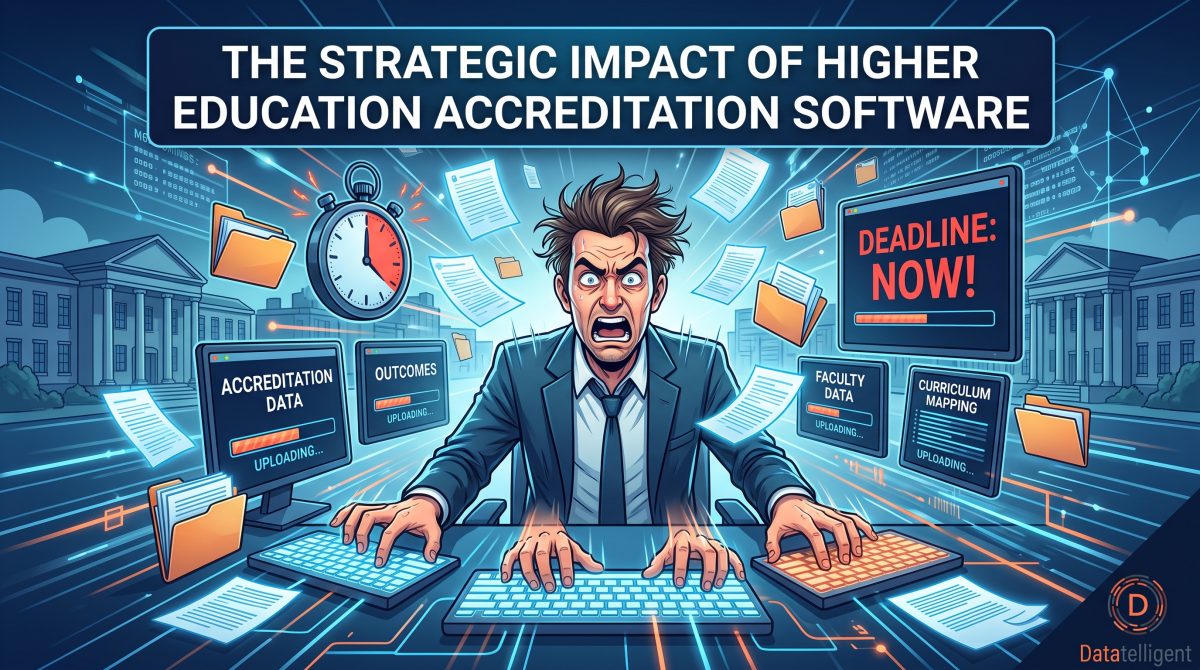
For many Institutional Effectiveness (IE) and Institutional Research (IR) teams, the word “accreditation” triggers a familiar sense of dread. It signals the start of the “Great Data Scramble”—a frantic, months-long process of emailing department heads, hunting down spreadsheets, and piecing together fragmented evidence to prove your institution is meeting its standards. 

While accreditation is meant to foster continuous improvement, the process of reporting often feels like a massive distraction. The sheer burden of data collection—pulling numbers from your Student Information System (SIS), Learning Management System (LMS), and financial software—can paralyze a team. 

If you are spending 80% of your time collecting data and only 20% analyzing it, the balance is wrong. It’s time to talk about why the old way of reporting is broken and how Unified Data offers a path out of the weeds. 

The Hidden Cost of the “Template Trap” 

The most common tool for accreditation reporting is still, unfortunately, the static spreadsheet. You likely have a folder full of “Common Data Set” templates or custom Excel files that you email to the Registrar, the Provost, and the CFO, hoping they fill them out correctly. 

While these templates provide a structure, they create three major burdens: 

The Version Control Nightmare 

We have all seen it: Enrollment_Data_Final_v3_ACTUAL.xlsx. When you rely on emailed templates, you aren’t managing data; you are managing files. Reconciling conflicting numbers from different stakeholders becomes a full-time job. 

The “Snapshot” Fallacy 

Accreditation bodies like HLC, SACSCOC, and NECHE increasingly demand evidence of continuous improvement. A static template captures a snapshot of your institution from six months ago. By the time the visiting team arrives, that data is stale, making it difficult to answer real-time questions about student success trends. 

Moving From “Collection” to “Connection” 

To lift the burden of accreditation, institutions need to stop asking “Who has this spreadsheet?” and start asking “How does our data flow?” 

The solution lies in Unified Data. Instead of manually harvesting data every ten years (or every reporting cycle), modern institutions are building “always-on” data lakes. When your data is unified, accreditation metrics—like retention rates, faculty credentials, and financial health ratios—are calculated automatically and continuously. 

How Datatelligent Automates the Evidence Room 

At Datatelligent, we believe that compliance shouldn’t come at the cost of your sanity. That’s why we built the Fusion Platform to automate the heavy lifting of higher ed data. 

Automate Ingestion with Fusion Flow 

The biggest bottleneck in accreditation is getting the data out of your siloed systems. Fusion Flow orchestrates the collection of data from every source—your SIS, CRM, LMS, and more—and automates the ingestion into a centralized Data Lake. No more manual exports; the data is simply there, ready for analysis. 

Visualizing Compliance with Fusion Vision 

Once your data is harmonized, Fusion Vision turns that raw information into intelligent insights. Imagine an “Accreditation Dashboard” that updates daily, allowing you to monitor your Key Performance Indicators (KPIs) year-round. When the self-study rolls around, you don’t need to scramble for evidence; you just point to the dashboard. 

Free Tools to Get Started 

We know that unified data is a journey. To help you benchmark your current standing, we offer resources like our Free IPEDS Comparison Tool. It’s a great example of how visualizing public data can save you hours of manual cross-referencing. 

Turn Compliance into Strategy 

Accreditation shouldn’t be a burden you survive; it should be an opportunity to thrive. By shifting from manual templates to a unified data platform, you can give your team the time they need to focus on what matters most: using that data to drive student success. 

Explore the Fusion Platform and see how we unify your data ecosystem. 

Categories
Blog

From Data Custodians to Strategic Partners: Solving the Data Wrangling Crisis in Institutional Research

If you ask Institutional Research (IR) or higher education analytics teams how they spend their time, the answer is often the same, just phrased differently:

  • “We’re constantly pulling data.”
  • “We spend more time cleaning than analyzing.”
  • “By the time the report is done, the question has already changed.”

This isn’t a skills problem. It’s not a motivation problem. And it’s certainly not because higher education lacks data.

It’s a Data Wrangling problem.

The Hidden Cost of Manual Data Wrangling

On most campuses, answering even a straightforward question requires a familiar sequence of manual data wrangling tasks:

  1. Pull data from multiple systems
  2. Normalize formats and definitions
  3. Reconcile inconsistencies
  4. Validate results
  5. Rebuild the same logic again next month

This work is necessary but it’s also repetitive, fragile, and time-consuming. It quietly consumes the time and attention of some of the most analytically capable people on campus.

The result is that highly trained Institutional Research professionals become data custodians, keeping systems running, reports updated, and requests fulfilled, rather than strategic partners helping leadership think ahead.

Why Weak Data Governance Stalls Strategic Planning

When data governance is an afterthought and preparation dominates the workflow, institutions fall into a reactive rhythm:

  • Reports are built on fixed schedules
  • Questions are answered after decisions are already in motion
  • Follow-up questions trigger another round of manual work

Even when leadership wants to plan more proactively, the reporting cycle becomes a constraint. Not because people aren’t asking the right questions, but because the governance frameworks aren’t in place to make data ready when they need it.

This creates a frustrating gap between what leaders want (insight, context, options) and what teams can deliver (static snapshots built after the fact).

Automating Data Flows to Empower Institutional Research

Reducing the data wrangling burden doesn’t start with better dashboards or more tools. It starts earlier, with how data moves.

When data flows are automated and backed by strong data governance standards:

  • Data arrives consistently, not manually
  • Logic is defined once, not recreated repeatedly
  • Updates happen continuously, not on request

This significantly shifts the role of Institutional Research teams. Instead of spending their time preparing data, they can spend it interpreting, contextualizing, and advising.

Moving from Descriptive to Prescriptive Analytics

That’s the difference between answering: “What happened last term?”

and helping leaders ask: “What’s changing, and what should we do next?”

The Real Outcome: Time for Student Success & Strategy

The most valuable outcome of reducing the data wrangling burden isn’t faster reports. It’s time.

Time to:

  • Explore trends instead of just summarizing them
  • Ask better questions
  • Connect data across enrollment, finance, and Student Success
  • Support planning rather than chasing deadlines

In an environment where institutions are being asked to do more with fewer resources, freeing up analytical capacity isn’t a luxury; it’s a necessity.

A Practical Path: Data Flows as the Foundation for Data Governance

Reducing the burden doesn’t require ripping out systems or rebuilding everything at once. On many campuses, the biggest gains come from improving how data flows between existing systems.

This is where the right infrastructure makes the difference. At Datatelligent, Data Flows play a foundational role in the Fusion Platform. By automating and standardizing extraction, transformation, and delivery, Data Flows help institutions enforce data governance while eliminating repetitive preparation.

When data flows are dependable, Institutional Research teams spend less time wrangling inputs and more time partnering with leaders on interpretation, planning, and decision-making. That shift, from preparation to perspective, is what enables analytics teams to operate strategically rather than reactively

Categories
Blog Uncategorized

Fusion Platform Series (Part 3): Unlocking Institutional Intelligence with Fusion Vision

Welcome to the finale of our Fusion Platform blog series.

In Part 1, we built the pipelines with Data Flows. In Part 2, we centralized and organized that information into the Data Lake using our preset higher education models.

Now, we arrive at the moment where all that infrastructure pays off. It’s time to turn raw data into strategic power.

Welcome to Fusion Vision.


Moving Beyond Static Reporting to Dynamic Higher Education Analytics

For many institutional research professionals, the job often feels like being a “report factory.” You spend weeks building a static report, and by the time it reaches leadership, the data is stale, or they have a follow-up question that requires another week of work.

Fusion Vision changes this dynamic. Because we have already standardized and modeled the data in the Data Lake (Step 2), we can now instantly layer powerful visualization tools on top of it.

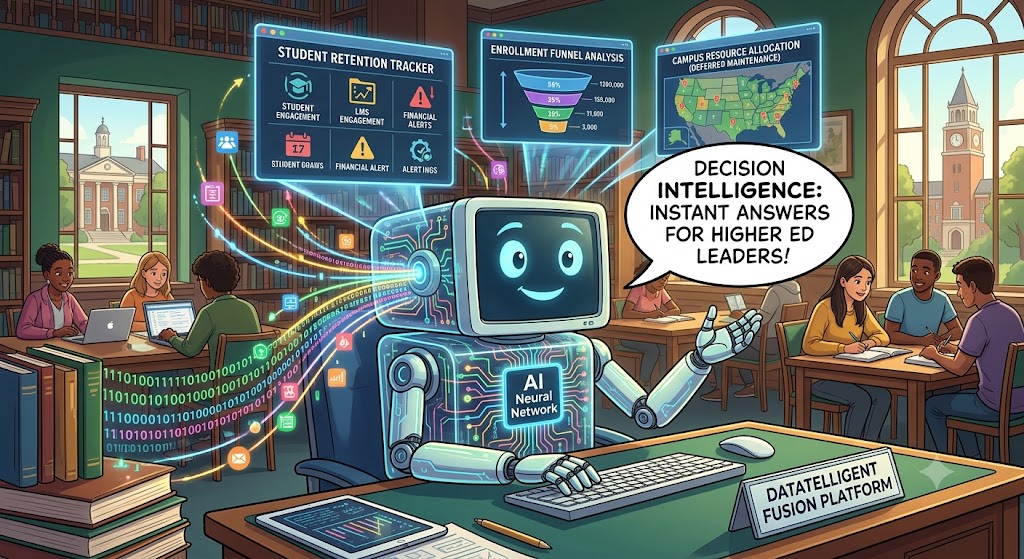
This isn’t just about making pretty charts; it’s about speed and accessibility. Fusion Vision allows you to move your data effortlessly into interactive KPI dashboards that track enrollment, retention, and student success in real-time.


Democratizing Data: Insights for Everyone

The true goal of the Fusion Platform is to break down the walls around data. Historically, only a few people with SQL skills could access the “source of truth.”

With Fusion Vision, we democratize access. Whether it’s the Provost, the Dean of Student Affairs, or the Financial Aid office, stakeholders get secure access to the insights they need without having to submit a ticket to IT.

The Power of AI and Chatbots in Higher Ed

One of the most exciting additions to Fusion Vision is the integration of AI-driven Chatbots.

Imagine a Dean asking a plain-language question like, “What is the retention rate for first-generation students in the College of Arts & Sciences?” and getting an immediate, accurate answer visualized in a chart.

Because our preset models in the Data Lake have already defined the relationships between your data points, our AI tools can accurately interpret these questions. This empowers decision-makers to self-serve, freeing up the Institutional Research team to focus on complex, high-level strategic analysis rather than ad-hoc queries.


Survival of the Fittest: Why Colleges Need Intelligent Insights

In today’s competitive landscape, higher education institutions are under immense pressure. Enrollment cliffs, budget constraints, and retention challenges mean that colleges cannot afford to fly blind.

Fusion Vision delivers the intelligent analytics solutions required not just to operate, but to survive and thrive. By connecting the dots between disparate data sources—from the LMS to the ERP—you can spot at-risk students earlier, optimize financial aid distribution, and predict enrollment trends with greater accuracy.


The Complete Fusion Journey

We hope you’ve enjoyed this series on the Datatelligent Fusion Platform.

  1. Data Flows ensure your data moves securely and automatically.
  2. The Data Lake organizes and models it for higher education.
  3. Fusion Vision delivers the insights, dashboards, and AI tools that drive action.

Ready to see how Fusion Vision can transform your institution’s data culture? Explore our Analytic Solutions here.

Categories
Blog

Fusion Platform Series (Part 2): The Power of the Higher Education Data Lake 

In Part 1 of our Fusion Platform series, we discussed Data Flows—the critical pipelines that automate the extraction of data from your Student Information System (SIS), Learning Management System (LMS), and other campus sources. 

But once that data is flowing, where does it go? It needs a destination that is more scalable than a spreadsheet and more flexible than a traditional warehouse. 

Welcome to step two of the Fusion Platform: The Datatelligent Data Lake

Shutterstock 

Centralizing Your Institutional Research Data Management 

For many universities, data storage is just as fragmented as data collection. You might have financial data in one server, student success metrics in another, and alumni records in a third. This fragmentation makes “big picture” analysis nearly impossible. 

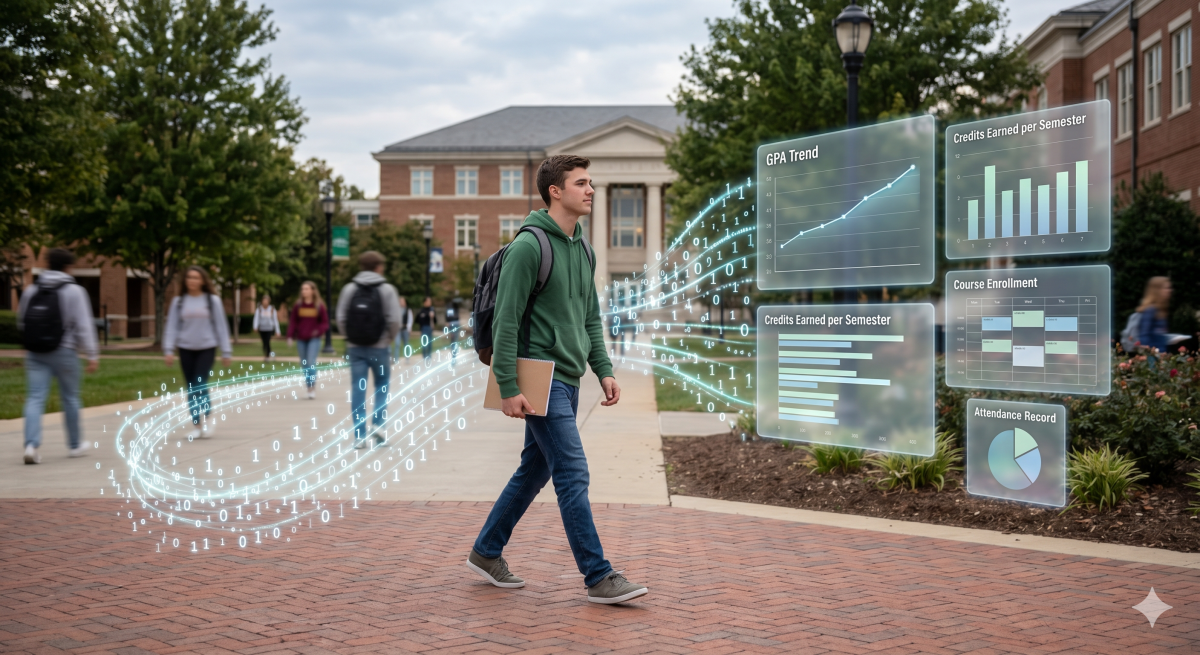
The Datatelligent Data Lake acts as the central reservoir for all this incoming information. By directing your Data Flows into a single, unified environment, we eliminate data silos. This consolidation is the first requisite for advanced higher education data analytics, allowing you to see the interplay between a student’s financial aid status, their LMS engagement, and their retention likelihood. 

Preset Models: Transforming Raw Data into Strategic Assets 

A common fear for research professionals is that a “Data Lake” will turn into a “Data Swamp”—a messy dumping ground where information gets lost. 

The Fusion Platform prevents this by utilizing preset higher education data models. When your data flows from your ERP or CRM into our Data Lake, it doesn’t just sit there in a raw, unusable state. It flows into pre-built, standardized structures designed specifically for the unique complexities of the higher education environment. 

These models automatically organize your data, saving your team hundreds of hours of manual engineering. It ensures that data from disparate sources is not just stored, but harmonized, ready for complex querying. 

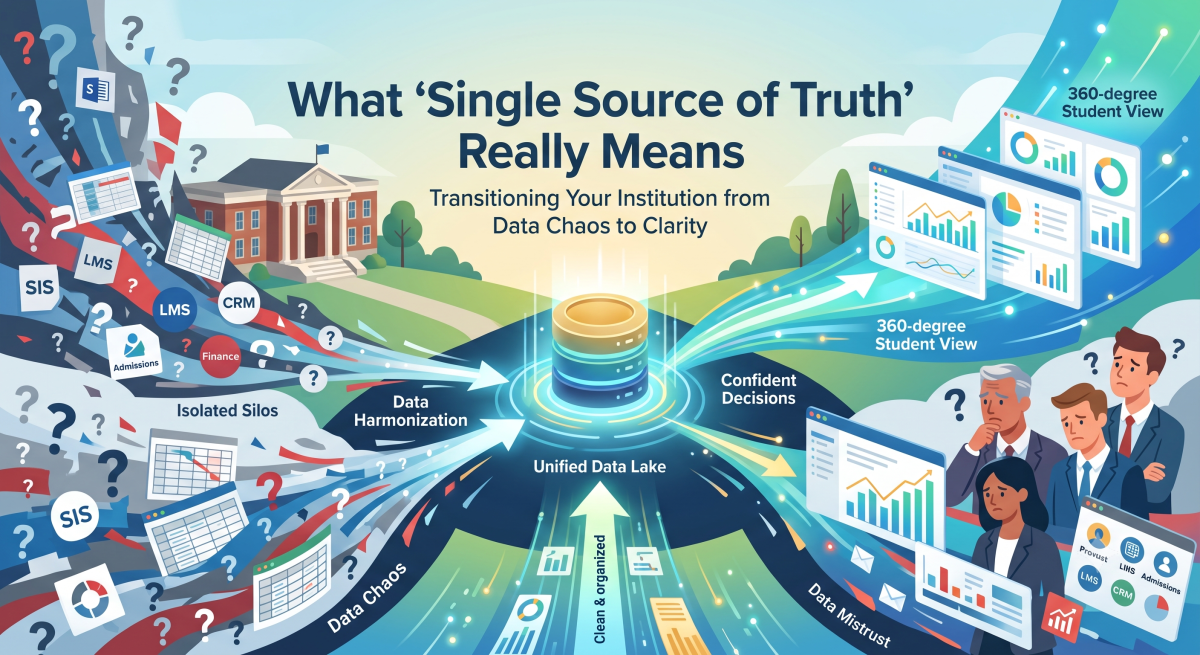
Unifying Student Data Sources for a Single Source of Truth 

The true magic happens when these sources combine. In the Data Lake, your LMS engagement data can finally “talk” to your SIS demographic data. 

  • Integration: We merge records to create a 360-degree view of the student. 
  • Scalability: Unlike legacy storage, our Data Lake scales infinitely as you add more history or new software tools. 
  • Speed: With the data pre-modeled, you cut down the “time-to-insight” significantly. 

Preparing for the Future: Analytics and Dashboards 

Think of the Data Lake as the foundation of a house. You cannot build the beautiful, functional rooms (dashboards and visual reports) without a solid concrete slab. 

By consolidating and modeling your data here, you are prepping your institution for the final and most exciting step of the Fusion Platform: Fusion Vision. The work we do in the Data Lake today allows us to easily query data and pull it into stunning, actionable dashboards later—which is exactly what we will cover in the next blog post. 

Dive Deeper into Data Lakes 

Want to understand the technical benefits and security features of this architecture? We have a comprehensive resource that goes into the fine details. Read our Deep Dive: Unlock the Potential of Your Data with a Data Lake 

Stay tuned for Part 3, where we will discuss how to visualize this data to drive decision-making. 

Categories
Blog

Fusion Platform Series (Part 1): Mastering Your Higher Education Data Flow

Management 

For years, we at Datatelligent have been dedicated to building a platform that truly solves the complex data challenges facing higher education. We’re thrilled to introduce a new blog series that will walk you through each component of our powerful Fusion Platform

We begin with the foundational first step, the very heartbeat of the platform: Data Flows

What Are Data Flows and Why Do They Matter? 

In any institution, but especially in higher education, data is being generated constantly from a dozen different places. The challenge isn’t a lack of data; it’s that the data is siloed, messy, and difficult to harness. 

Data Flows are the solution. They are the engine powering the seamless movement of data from all your essential higher education systems—from the Student Information System (SIS) to the Learning Management System (LMS) and your Customer Relationship Management (CRM) platforms. This data is then channeled into one centralized, secure location. 

Solving the Core Challenge: Higher Education Data Integration 

For too long, institutional research professionals have been burdened with the time-consuming, frustrating task of “manual data wrangling.” You know the drill: exporting spreadsheets, cleaning columns, and trying to manually stitch together reports from systems that were never designed to talk to each other. This process is not just inefficient; it’s prone to errors that can lead to flawed insights. 

From Manual Wrangling to Automated Student Data Pipelines 

The Fusion Platform’s Data Flows eliminate this problem entirely. We connect your disparate systems through secure, automated pipelines

This means you and your team are no longer spending your valuable time as data janitors. Instead, the data is automatically extracted, standardized, and loaded, freeing you to focus on what you do best: analysis and generating insights that drive student and institutional success. 

Meeting Your University Where It Is 

We understand that every institution has a unique technology stack. Data Flows are designed to connect with the systems you already have. Whether it’s data from across the student lifecycle, financial aid, or alumni relations, our platform meets you where you are, ensuring that all relevant data collection areas are integrated. 

The Ultimate Benefit: A Single Source of Truth for Institutional Research 

When your data is automatically managed and centralized, the result is transformative. You get a single, trusted source of truth

No more conflicting reports from different departments. No more questioning if you have the latest numbers. Data Flows ensure that your entire institution operates from one complete, accurate, and timely set of data. 

For a research professional, this is the bedrock of strategic decision-making. It enables you to deliver the timely, accurate insights your leadership needs with confidence. To see how this component works in more detail, you can learn all about our Data Flows for Higher Education solution. 

What’s Next? The Data Lake 

So, where do all these secure, automated data flows lead? 

They feed the next critical component of the Fusion Platform: the Data Lake. This is the central repository where your newly integrated, clean, and analysis-ready data is stored. 

In next week’s blog, we’ll dive into the Data Lake and explore how it serves as the foundation for powerful analytics, reporting, and predictive modeling. 

Stay tuned! 

Categories
Blog

Bigger, Bolder, and Brighter: Announcing the New Datatelligent! 

If you’ve visited datatelligent.ai recently, you might have noticed things look a little different. And you’re right! We’re thrilled to officially unveil our complete rebrand, complete with a new homepage, streamlined menus, and a refocused services page. 

This isn’t just a new coat of paint. This rebrand represents a major evolution for us and a doubling-down on our core mission. While we still proudly serve our partners in the non-profit sector, we are sharpening our focus to become the premier data and AI partner for Higher Education

Introducing The Fusion Platform 

A huge part of this new chapter is the launch of our core platform’s new name: The Fusion Platform. It’s the engine that drives everything we do, and we’ve broken it down into two distinct areas: 

  1. Fusion Flow: This is where the magic begins. Fusion Flow is all about taking the complex, siloed data sources from a college or university and seamlessly merging them into a unified data lake. We then harmonize this data with our prebuilt datasets, making it clean, accessible, and ready for insights. We leverage our powerful partnership with Snowflake to handle the heavy lifting, ensuring your data is secure, fast, and scalable. 
  1. Fusion Vision: Once your data is in order, Fusion Vision is how we bring it to life. This is where we focus on Intelligent Insights that empower measurable outcomes. Built specifically for higher education, our Intelligent Insights connect every stage of the student lifecycle—from Attract to Thrive. This isn’t just about showing static data; it’s about transforming your harmonized data into a deeper understanding of what’s happening. By combining advanced analytics, machine learning, and generative AI, we help you uncover patterns, predict outcomes, and take decisive action to improve both student success and institutional performance. With Intelligent Insights, your institution can identify prospective students most likely to enroll, anticipate retention risks well before they happen, and measure progress toward your strategic goals with unparalleled precision. 

Beyond Insights: AI-Powered Answers 

We’re also looking to the future. A key part of our rebrand is a massive push into Artificial Intelligence. While our Intelligent Insights provide a deep, predictive view of your institution, we know that leaders also need on-demand answers. 

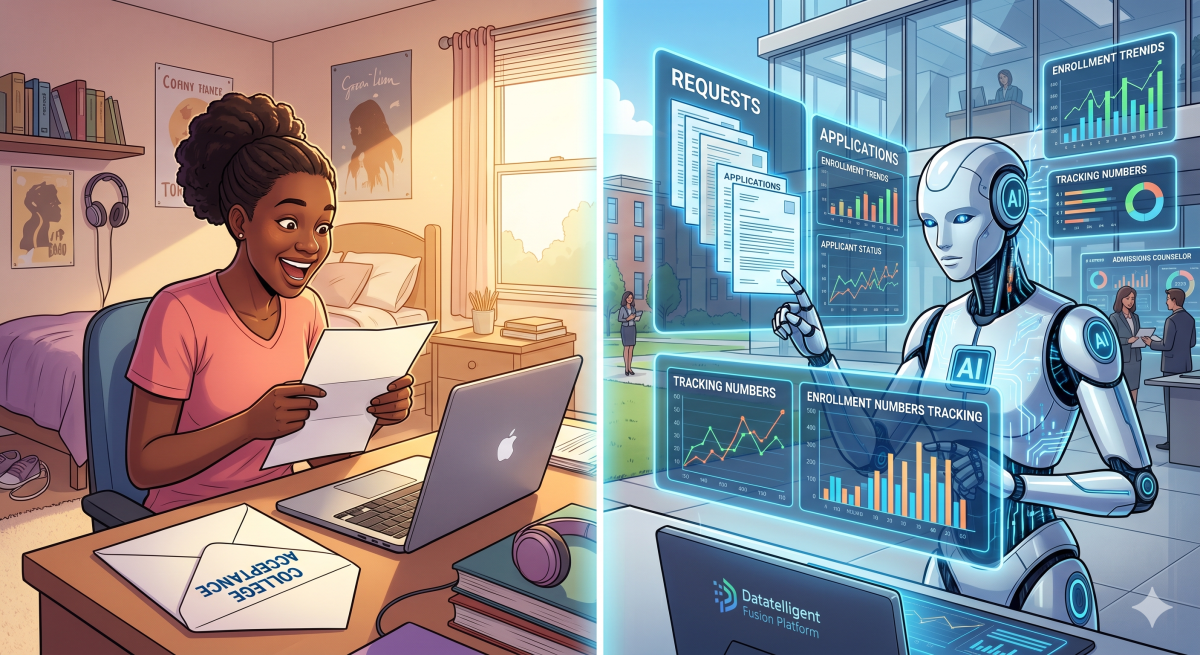
That’s why we’re developing new generative AI capabilities for our platform. Imagine a university president simply asking a chatbot, “What is our current freshman enrollment compared to this time last year?” and getting an instant, accurate answer pulled directly from their harmonized data. That’s the future we’re building—faster, more intuitive, AI-enabled access to insights for everyone. 

We’re incredibly proud of the work this rebrand represents. As our CEO, Larry Blackburn, notes: 

“With the Fusion Platform we are providing the quickest path, from data to intelligent insights, from question to answer, so our customers can focus on driving outcomes!” 

A New Look to Match Our Vision 

As you explore the new site, be sure to check out two new graphics we’re especially excited about. 

  • One is a circular diagram that shows all the different areas our platform and services cover. 
  • The other is a comprehensive square diagram that walks you through the entire journey of our platform—from initial data collection all the way to gaining valuable, AI-driven insights about the student lifecycle. 
Datatilligent Fusion Diagram for Higher Education

This rebrand is more than a new look; it’s a commitment to our partners in higher education. We’re here to help you unlock the full potential of your data to make smarter, faster decisions that help your students and institution thrive. 

We invite you to explore the new Datatelligent.ai and see the future of data in higher education. 

Categories
Blog

Is Your College’s Software About to Expire? Navigating the End-of-Life Challenge in Higher Ed 

In the world of higher education IT, few announcements cause as much collective anxiety as a software end-of-life notice. It’s a familiar story for many institutions: a core piece of your software infrastructure, something your teams have used for years, is being deprecated. This isn’t a new problem. Many of us remember the days of migrating off of clunky, outdated Content Management Systems (CMS) or homegrown student information systems that had become too cumbersome to maintain. 

Today, that cycle continues with a significant deadline looming for many. Ellucian is officially sunsetting its popular Banner On-Premise solution, setting a hard deadline for users to migrate to their cloud software by the end of 2025. For the hundreds of colleges that have built their data stacks around the local control and stability of Banner On-Prem, this isn’t just an upgrade—it’s a fundamental shift that can feel forced and restrictive. 

This common “one-key” approach, where a vendor sunsets a product and presents their proprietary cloud replacement as the only path forward, often overlooks the unique needs, budgets, and strategic goals of each institution. It’s like being told you have to replace your entire door just because the lock manufacturer has a new model they want you to buy. 

The Locksmith Approach to Data Migration 

At Datatelligent, we see things differently. We believe you shouldn’t be locked into a single solution. Instead of being a key-maker with one answer, we act as your institution’s locksmith—a strategic partner with a full set of tools to craft the solution that is right for you

Our philosophy is built on a hybrid, data-team approach. We understand that “moving to the cloud” isn’t a one-size-fits-all strategy. You have unique security requirements, established workflows, and a complex ecosystem of existing technology. Our goal is to work with you, not just for you, to navigate these transitions without disrupting your operations or forcing you into a corner. 

Leverage Your Existing Stack, Avoid the Red Tape 

One of the biggest hurdles in adopting new technology in higher education is the dreaded Request for Approval (RFA) process. It’s slow, complex, and can stifle innovation. Datatelligent’s approach is designed to minimize this friction. We specialize in working with the stack of tools your college already has and is approved to use. By integrating with your current environment, we help you modernize your data infrastructure without launching a dozen new approval processes. 

Furthermore, in some cases, we even have an existing Request for Approval at the state level for community college systems. If you’re part of one of these groups, partnering with us can be an incredibly streamlined process. We encourage you to ask our team if this approach can benefit your institution. 

Future-Proof Your Institution with a Data Lake 

Whether you’re moving off Ellucian Banner On-Prem or another piece of deprecated software, our data lake strategy is the key to a smoother, more valuable transition. By migrating your data from a legacy system into a centralized data lake, you decouple your valuable information from the software itself. 

This accomplishes two critical goals: 

  1. Immediate Modernization: You don’t have to wait for a full system replacement to start leveraging your data. Our custom data sets allow for the easy flow of information into powerful KPIs and dashboards, delivering actionable insights to your leadership today. 
  1. Long-Term Flexibility: Once your data is in a flexible, modern data lake, you are no longer captive to a single software vendor. Future migrations and integrations become vastly simpler, giving you the freedom to choose the best tools for your institution down the road. 

Don’t let a software sunset dictate your institution’s future. You have more options than you think. Contact the Datatelligent team today to learn how our locksmith approach can help you unlock your data’s true potential and build a more agile, resilient technology strategy for tomorrow. 

Categories
Blog

Higher Education Analytics: A New Era of Data-Driven Decisions 

Higher education analytics are no longer a luxury—they are a necessity. Colleges and universities are sitting on a goldmine of data, but too often, it’s siloed and inaccessible. This is where Datatelligent comes in. We provide the tools and expertise to transform your raw data into actionable insights, empowering you to make data-driven decisions that enhance the student lifecycle and improve institutional effectiveness. 

The Foundation: Centralizing Your Data 

The first step in leveraging your data is to bring it all together. Our Unified Data Solutions are designed to do just that. We create a centralized data lake, breaking down silos and providing a single source of truth. This process involves: 

  • Data Integration: We connect to your various data sources, from student information systems to learning management systems, and everything in between. 
  • Data Flows: Our automated data flows ensure that your data is always up-to-date and accurate. 
  • Scalability: Our platform is built to grow with you, so you can be confident that your data infrastructure will support your future needs. 

From Data to Meaning: Our Pre-Built Solutions 

Once your data is centralized, the next step is to make sense of it. This is where our pre-built analytics for higher education come into play. We’ve developed a suite of solutions specifically for colleges and universities, designed to address your most pressing challenges. These solutions include: 

  • Student Success Analytics: Identify at-risk students and intervene before it’s too late. 
  • Enrollment Analytics: Optimize your recruitment and admissions processes. 
  • Alumni Analytics: Strengthen your alumni relations and fundraising efforts. 

Actionable Insights: Visualizing Your KPIs 

The final step is to turn your data into actionable insights. Our platform includes a suite of powerful data visualization tools that make it easy to track your key performance indicators (KPIs). These dashboards provide a clear and concise overview of your institution’s performance, allowing you to: 

  • Monitor Student Success: Track retention rates, graduation rates, and other key metrics. 
  • Evaluate Program Effectiveness: Assess the performance of your academic programs and make data-driven decisions about resource allocation. 
  • Optimize the Student Lifecycle: From recruitment to graduation and beyond, our analytics provide the insights you need to improve the student experience. 

At Datatelligent, we’re more than just a technology provider. We’re your partner in data analytics in higher education. We offer a range of services to support you on your data journey, from our AI Starter Solutions to our Generative AI Foundations Course. Contact us today to learn more about how we can help you unlock the power of your data. 

Latest News
Days
Hours
Minutes