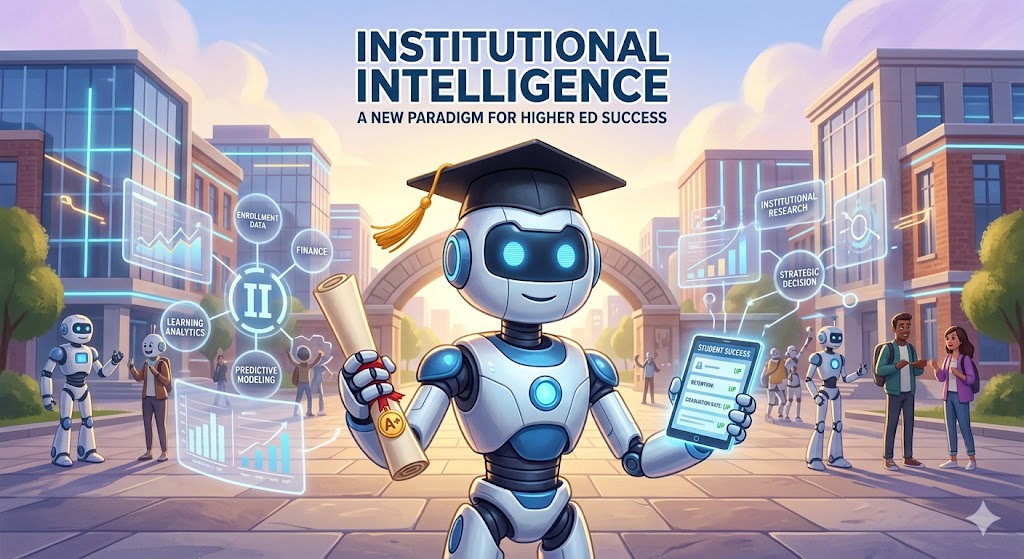
In the complex ecosystem of a modern campus data is generated every second. From the Registrar’s enrollment logs to the Learning Management System (LMS) activity, and from financial aid disbursements to alumni donations, higher education institutions are awash in information.
However, having data is not the same as having intelligence.
This distinction is where the concept of Institutional Intelligence (II) comes into play. As higher education faces mounting pressure to demonstrate value, improve retention, and optimize operations, understanding and defining Institutional Intelligence has become a critical mandate for administrators and Institutional Research (IR) departments alike.
Defining Institutional Intelligence
At its core, Institutional Intelligence is the capacity to use data, analytics, and cultural context to understand its own operations, predict future trends, and make evidence-based strategic decisions.
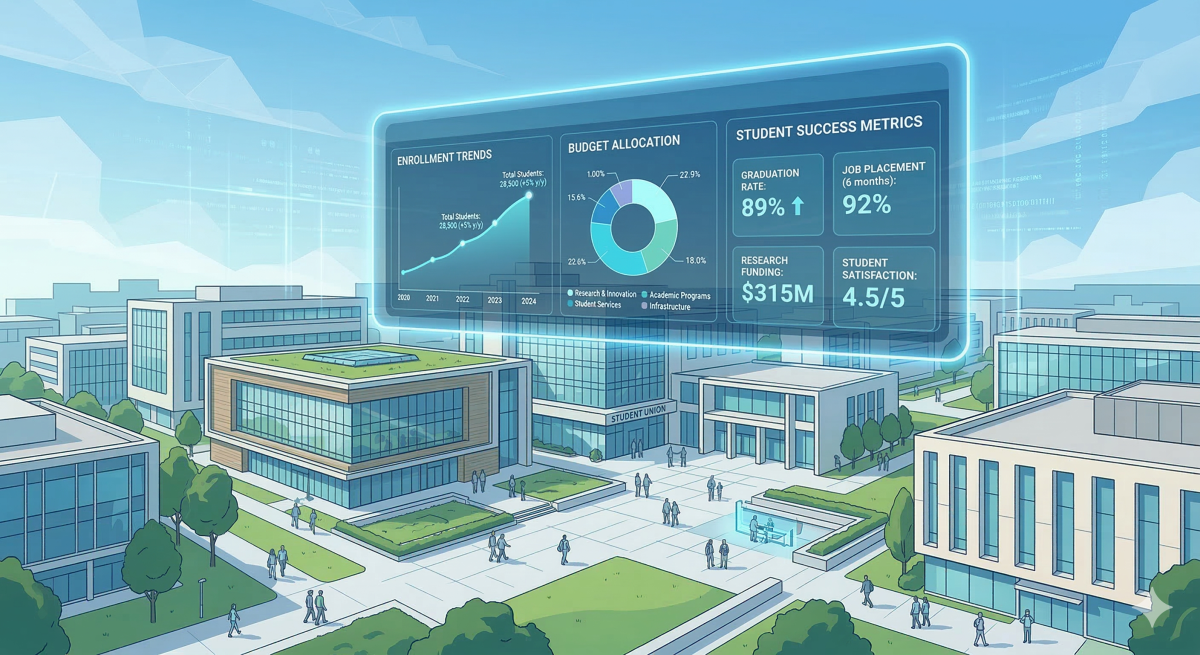
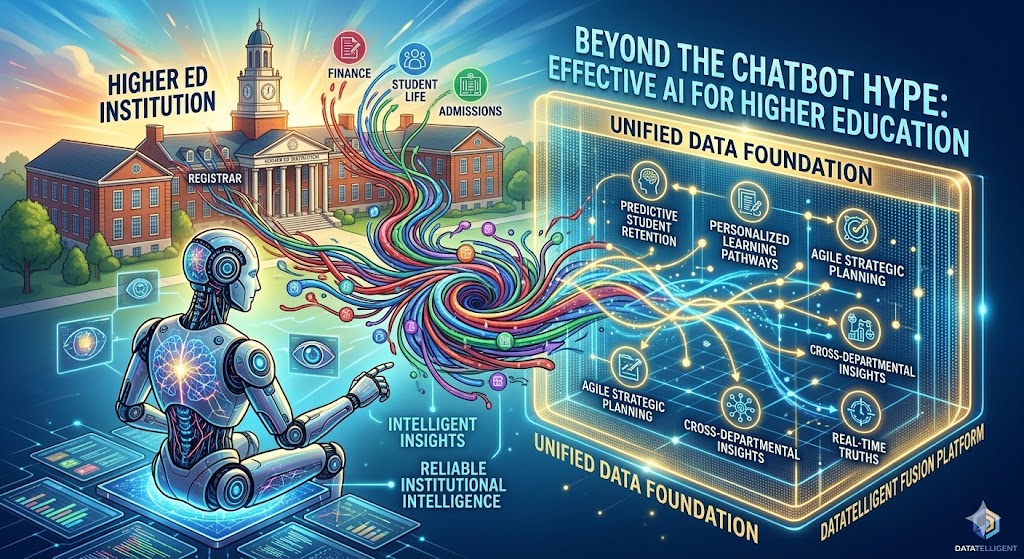
Unlike traditional Business Intelligence (BI), which often focuses on historical reporting (what happened?), Institutional Intelligence focuses on synthesis and foresight (why did it happen, and what will happen next?). It is the holistic integration of data sources across the entire campus—breaking down the walls between academics, finance, student life, and operations—to create a unified view of institutional health.
Beyond Standard Reporting
True Institutional Intelligence moves beyond static PDF reports and compliance spreadsheets that have long defined university administration. It transforms raw numbers into actionable insights that can be accessed by stakeholders at all levels, truly democratizing data across the organization.
The Evolution of Institutional Research (IR) Departments
Historically, Institutional Research (IR)/Institutional Effectiveness departments have been the guardians of higher ed data, primarily tasked with mandatory federal reporting (IPEDS) and ad-hoc internal requests. In the era of Institutional Intelligence, the role of the IR department is undergoing a profound shift.
From Data Stewards to Strategic Partners
Data professionals are no longer just “reporting compliance officers.” They are becoming the architects of Institutional Intelligence. By leveraging modern data warehousing and analytics platforms, knowledge management teams are able to move away from manual data cleaning tasks to focus on high-level analysis, serving as strategic partners who guide campus policy and practices.
Institutional Effectiveness and Accreditation
A key component of Institutional Intelligence is its role in Institutional Effectiveness (IE). Accrediting bodies now demand more than just data outputs; they require proof that the institution is using that data to improve student learning outcomes and operational efficiency. Institutional Intelligence provides the framework for this continuous improvement cycle, offering a real-time feedback loop that static reports cannot match.
Key Pillars of a Robust Institutional Intelligence Strategy
For an institiuation to claim it possesses Institutional Intelligence, it must move beyond siloed spreadsheets and adopt a mature data strategy.
Data Integration and Governance
Intelligence cannot exist in a vacuum. If financial data does not “speak” to enrollment data, the institution is flying blind. A foundational pillar of II is Data Centralization —the technical process of pooling data into a single source of truth, often a data lake or warehouse. This must be paired with strong Data Governance to ensure that definitions (e.g., “what counts as a full-time student?”) are consistent across the organization.
Predictive Analytics for Student Success
Perhaps the most valuable application of Institutional Intelligence is in Student Success. By analyzing historical trends and real-time behaviors, institutions can identify at-risk students weeks before they drop out. This shifts the paradigm from reactive intervention to proactive support, directly impacting retention rates and tuition revenue.
Conclusion: The Future of Higher Ed Decision Making
Institutional Intelligence is not a software product; it is an organizational capability. It represents a college or university’s ability to know itself deeply and act swiftly. As higher education continues to navigate demographic cliffs and financial constraints, the institutions that thrive will be those that treat their data not as a byproduct of operations, but as a strategic asset for intelligence.