Welcome to the finale of our Fusion Platform blog series.
In Part 1, we built the pipelines with Data Flows. In Part 2, we centralized and organized that information into the Data Lake using our preset higher education models.
Now, we arrive at the moment where all that infrastructure pays off. It’s time to turn raw data into strategic power.
Welcome to Fusion Vision.
Moving Beyond Static Reporting to Dynamic Higher Education Analytics
For many institutional research professionals, the job often feels like being a “report factory.” You spend weeks building a static report, and by the time it reaches leadership, the data is stale, or they have a follow-up question that requires another week of work.
Fusion Vision changes this dynamic. Because we have already standardized and modeled the data in the Data Lake (Step 2), we can now instantly layer powerful visualization tools on top of it.
This isn’t just about making pretty charts; it’s about speed and accessibility. Fusion Vision allows you to move your data effortlessly into interactive KPI dashboards that track enrollment, retention, and student success in real-time.
Democratizing Data: Insights for Everyone
The true goal of the Fusion Platform is to break down the walls around data. Historically, only a few people with SQL skills could access the “source of truth.”
With Fusion Vision, we democratize access. Whether it’s the Provost, the Dean of Student Affairs, or the Financial Aid office, stakeholders get secure access to the insights they need without having to submit a ticket to IT.
The Power of AI and Chatbots in Higher Ed
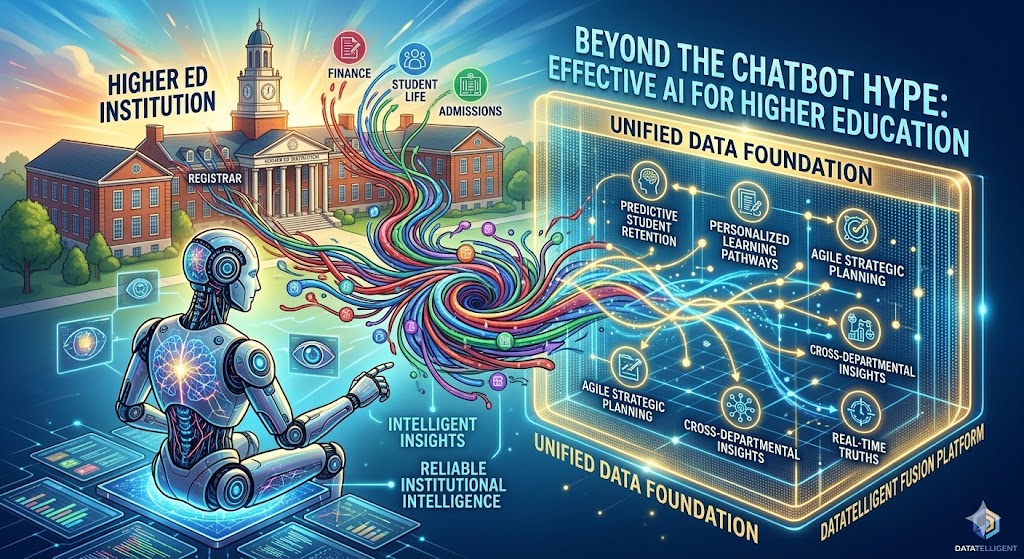
One of the most exciting additions to Fusion Vision is the integration of AI-driven Chatbots.
Imagine a Dean asking a plain-language question like, “What is the retention rate for first-generation students in the College of Arts & Sciences?” and getting an immediate, accurate answer visualized in a chart.
Because our preset models in the Data Lake have already defined the relationships between your data points, our AI tools can accurately interpret these questions. This empowers decision-makers to self-serve, freeing up the Institutional Research team to focus on complex, high-level strategic analysis rather than ad-hoc queries.
Survival of the Fittest: Why Colleges Need Intelligent Insights
In today’s competitive landscape, higher education institutions are under immense pressure. Enrollment cliffs, budget constraints, and retention challenges mean that colleges cannot afford to fly blind.
Fusion Vision delivers the intelligent analytics solutions required not just to operate, but to survive and thrive. By connecting the dots between disparate data sources—from the LMS to the ERP—you can spot at-risk students earlier, optimize financial aid distribution, and predict enrollment trends with greater accuracy.
The Complete Fusion Journey
We hope you’ve enjoyed this series on the Datatelligent Fusion Platform.
Data Flows ensure your data moves securely and automatically.
The Data Lake organizes and models it for higher education.
Fusion Vision delivers the insights, dashboards, and AI tools that drive action.
We are thrilled to announce the launch of Datatelligent’s new IPEDS Enrollment Comparison Tool, now available to you free of charge! This powerful tool is designed to help institutions easily explore enrollment trends and benchmark performance using comprehensive IPEDS data. You can access the tool and start your analysis today at Datatelligent Enrollment Comparison Tool.
Here are the quick steps to begin your comparison:
Select a School: In the top-left dropdown menu, click to expand the list. You can then use the search bar to quickly find your desired college by name.
Run Comparison: Once you select a school, the data comparison automatically runs, leveraging up-to-date IPEDS data.
Compare Multiple Institutions: The tool allows you to compare as many schools as you wish, providing instant insights into various enrollment metrics. You can view the percent change in enrollment over six years, graph enrollment headcount, and compare schools within the same sector, level, and region. The dashboard quickly shows six-year changes in student degree level, student intensity, and degree-seeking status.
Benchmark Performance Against Your Peers
Our comparison tool is exceptionally good for comparing your institution to peer schools. The chart automatically displays a trend line on your graph for similar colleges in your area, making it an excellent resource for benchmarking your performance against comparable institutions. This feature helps you quickly identify how your enrollment trends align with, or diverge from, those of your peers.
Ensuring Your Data Future
In an uncertain landscape where IPEDS data availability could be affected by government funding changes, Datatelligent provides a robust solution. We maintain a local copy of the IPEDS data, ensuring that you will continue to have access to this critical information even if the official IPEDS database becomes unavailable. We will be releasing a separate, in-depth article on this topic soon.
Just a Taste of What We Offer
While this free IPEDS Comparison Tool offers valuable insights, it’s only a glimpse of our full suite of capabilities. Datatelligent offers a comprehensive IPEDS Assistant, an advanced tooling solution that can automatically pull IPEDS data for you and perform a multitude of more complex comparisons tailored to your specific needs. To explore the full range of our offerings, visit our IPEDS Assistant Solutions Page. We encourage you to get in contact with us to learn more about how our advanced tools can empower your institution.
Join Our Upcoming Webinar
Have questions or want to see a live demonstration of the tool and our broader capabilities? We have a webinar coming up soon! Sign up here to secure your spot and gain further insights: Webinar Registration.
In today’s data-driven world, understanding how to store, manage, and analyze information is crucial for success. Two fundamental technologies often discussed are Database Management Systems (DBMS) or platforms, and Data Warehouses (DW). While both handle data, they serve distinct purposes and are optimized for different tasks. Confusing them can lead to inefficient processes and missed opportunities. At Datatelligent, we help organizations navigate these complexities. Let’s break down the key distinctions.
What is a Database Management System (DBMS) / Platform?
Think of a Database Management System as the engine that powers day-to-day operations. It’s software designed to create, read, update, and delete data in operational databases efficiently.
Purpose: Running the Business (OLTP)
A DBMS primarily supports Online Transaction Processing (OLTP). These are the frequent, short transactions essential for everyday business functions:
Processing a customer order
Updating inventory levels
Registering a student for a course
Recording a bank transaction
The focus is on speed, accuracy, and consistency for current operations.
Key Characteristics
Real-time Data: Reflects the current state of the business.
Normalized Structure: Data is typically organized to minimize redundancy and improve data integrity, often spread across many related tables.
Optimized for Writes: Designed for frequent insertions, updates, and deletions.
Focused Scope: Often supports a specific application or business process.
What is a Data Warehouse (DW)?
A Data Warehouse, on the other hand, is designed specifically for analysis and reporting. It consolidates data from various operational systems (often managed by DBMS) into a central repository optimized for querying and business intelligence.
Purpose: Analyzing the Business (OLAP)
Data Warehouses support Online Analytical Processing (OLAP). The goal is to analyze historical data to identify trends, patterns, and insights:
Analyzing sales performance over the last five years
Tracking marketing campaign effectiveness
Understanding long-term student retention rates
Generating quarterly financial reports
The focus is on query performance and providing a comprehensive view for decision-making.
Key Characteristics
Historical Data: Stores large volumes of data accumulated over time.
Optimized Structure for Reads: Often uses denormalized or specialized structures (like star or snowflake schemas) to speed up complex analytical queries.
Optimized for Reads: Designed for efficiently querying large datasets. Updates are typically done in batches (e.g., nightly loads).
Integrated Scope: Pulls data from multiple sources across the enterprise.
The Key Difference Between Data Warehouse and Database Management System
Feature
Database Management System (DBMS)
Data Warehouse (DW)
Primary Goal
Run daily operations (OLTP)
Analyze business performance (OLAP)
Data Focus
Current, real-time data
Historical, aggregated data
Data Structure
Normalized (reduces redundancy)
Often Denormalized (optimizes queries)
Processing
Fast transactions (read, write, update)
Complex analytical queries (read-heavy)
Update Freq.
Constant, real-time updates
Periodic batch loads
Scope
Application-specific or departmental
Enterprise-wide, integrated view
Users
Front-line workers, applications, DBAs
Business analysts, data scientists, execs
Data Management in Data Warehouse Environments
Effective data management in data warehouse scenarios is crucial. It involves more than just storage; it’s about ensuring data quality, consistency, and accessibility for analysis. This typically involves robust ETL (Extract, Transform, Load) or ELT (Extract, Load, Transform) processes to pull data from source systems (often managed by DBMS), clean and reshape it, and load it into the management data warehouse structure. Governance, metadata management, and security are also key components of managing a DW effectively. The goal is to create a reliable “single source of truth” for analytical purposes.
The Silo Effect: When Traditional Data Systems Create Barriers
A significant challenge many organizations face, even those with data warehouses, is the persistence of data silos. This often happens when:
Departmental Solutions: Different departments implement their own databases or even separate data marts (smaller, focused data warehouses) without central coordination.
Software Limitations: Specific applications (like CRM, ERP, LMS) act as isolated database management platforms, storing valuable data that isn’t easily integrated elsewhere.
Legacy Systems: Older systems may be difficult to connect to modern warehousing solutions.
Lack of Strategy: Without a unified data strategy, data naturally fragments across various systems.
These silos prevent a holistic view of the organization. Marketing data might be separate from sales data, which is separate from operational data, making comprehensive analysis difficult or impossible. As we discussed in our recent article, combining these fragmented sources into a unified platform, like a data lake, is often the next step to unlock the full potential of an organization’s data.
Higher Education: A Case Study in Data Silos
We see this challenge frequently in the Higher Education sector. Institutions rely on multiple specialized platforms, each acting as its own data management system:
Learning Management Systems (LMS): Platforms like Canvas or Moodle store rich data about course engagement, assignment submissions, and student interactions within courses.
Student Information Systems (SIS): Systems like Banner or PeopleSoft manage student records, registration, grades, financials, and demographic information.
Admissions/CRM Systems: Tools used for recruitment and managing prospective student data.
Financial Systems: Platforms managing budgets, grants, and institutional finances.
Each platform is essential, but they often operate in isolation. Getting a simple report, like correlating student engagement in Canvas with their final grades and demographics stored in Banner, can become a major technical hurdle. This difference between data warehouse and database management system approaches becomes stark – the operational systems (LMS, SIS) hold the data, but analyzing it together requires a dedicated analytical layer, like a well-designed data warehouse or data lake, to break down the silos.
Datatelligent: Your Partner in Unified Data
Understanding the difference between data warehouse and database management system tools is the first step. The next is implementing the right strategy for your organization’s unique needs.
Whether you’re struggling with data silos created by multiple database platforms, looking to build your first management data warehouse, optimize an existing one, or explore modern solutions like data lakes, Datatelligent can help. We meet you where you are in your data journey, providing the expertise and solutions needed to integrate your data, eliminate silos, and empower data-driven decision-making.
Contact Datatelligent today to learn how we can help you unlock the true value of your data.