Higher education has always been in the business of student success. What it has struggled with is knowing, in real terms, what that success actually costs and whether the investments being made are working.
That question has never been more urgent. According to Inside Higher Ed’s 2025 survey, only 28% of Chief Business Officers are highly confident in their institution’s business model. At the same time, affordability remains students’ top concern, and Chief Academic Officers are sounding the alarm about the future of financial aid amid ongoing federal and state funding uncertainty.
Institutions are being asked to do more for students with less certainty about the availability of resources. That is a difficult position to be in, and it becomes nearly impossible when the data needed to make smart decisions is fragmented across systems that don’t talk to each other.
The Silo Problem Nobody Talks About Directly
Ask most institutions whether they track enrollment, financial aid, and retention data, and the answer will almost universally be yes. Ask whether those data sets live in a single, connected view that leaders can act on, and the answer changes quickly.
Enrollment data lives in the SIS. Aid data lives in financial systems. Retention and student success metrics live somewhere else entirely, often managed by a separate team with a separate toolset. Each system is doing its job. The problem is that none of them are talking to each other in a way that surfaces the full picture.
The result is a common and costly gap: institutions are investing in student success without a clear line of sight into which investments are actually moving the needle. Retention initiatives get funded. Aid packages get awarded. Enrollment targets get set. But whether those efforts are connecting, whether a student who received a targeted aid package was more likely to persist, for example, often goes unmeasured simply because the data required to answer that question spans systems that were never designed to work together.
What the Full Picture Actually Reveals
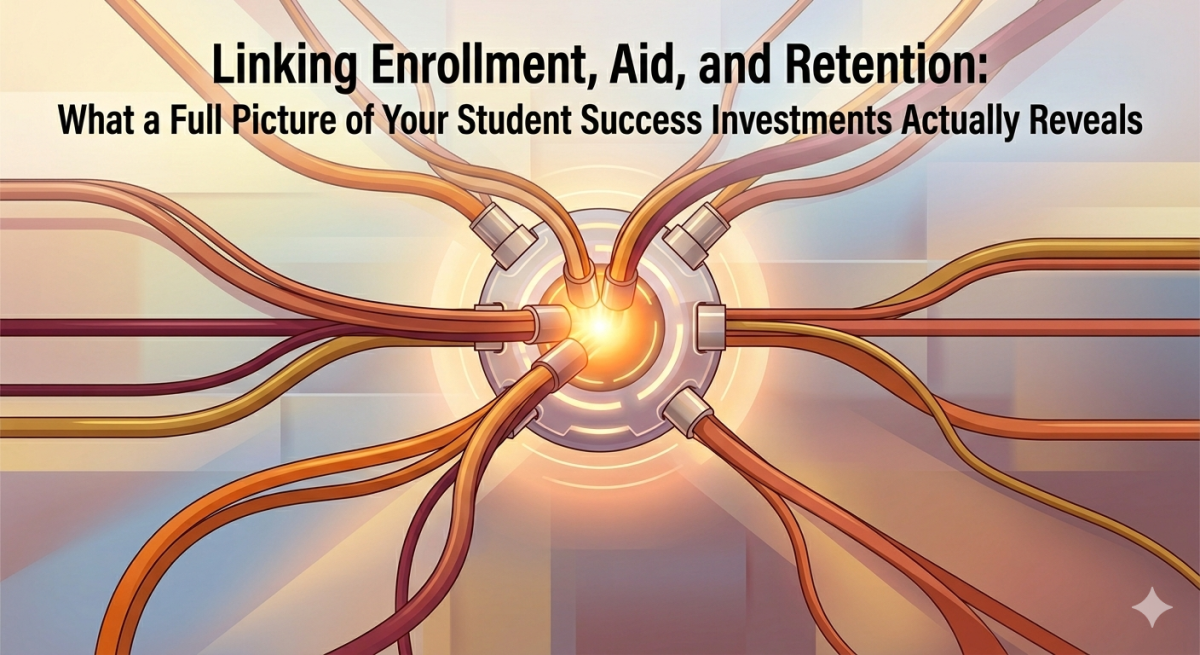
When enrollment, aid, and retention data are unified into a single view, something important happens: patterns that were invisible become actionable. Institutions can begin to see which student populations are most financially vulnerable and most at risk of stopping out, before it happens. They can identify whether aid awards are reaching the students who need them most, or whether gaps exist that are quietly driving attrition. They can connect the dots between enrollment trends, aid utilization, and persistence rates to inform both immediate interventions and longer-term strategies.
This is the difference between spending on student success and investing in it. Spending happens when resources are allocated based on assumptions and historical patterns. Investing happens when decisions are driven by current, connected data that shows what is actually working.
The Cost of Not Connecting the Dots
There is a tendency in higher education to think of data integration as a technology problem, something the IT team will eventually get to. But the real cost is strategic, not technical.
When finance and student success operate from disconnected data, budget conversations happen in a vacuum. Aid decisions are made without full visibility into their downstream impact on retention. Enrollment projections don’t account for the students most likely to leave. And when leadership asks whether the institution’s student success investments are paying off, the honest answer is often: we think so, but we can’t clearly show you.
In an environment where only 28% of CFOs feel confident in their business model, and funding uncertainty is the norm, “we think so” is not a sufficient answer. Boards want evidence. Accreditors want outcomes. Students and families want to know their investment is worth it.
From Siloed Metrics to Strategic Clarity
Connecting enrollment, aid, and retention data isn’t about adding more reports to an already crowded dashboard environment. It’s about replacing disconnected snapshots with a coherent institutional narrative, one that lets leaders ask better questions and get answers while there is still time to act on them.
That means knowing which students are at financial risk right now, not at the end of the term. It means understanding whether current aid strategies are supporting persistence or just reducing short-term attrition. It means being able to walk into a budget conversation with data that connects investment to outcome, rather than defending spending based on intuition.
For institutions navigating the current funding environment, that kind of clarity isn’t a luxury. It’s a strategic necessity.
At Datatelligent, the Fusion Platform is built to do exactly this, bringing together the data that institutions already have across their key systems and making it visible, connected, and actionable in a single environment. When enrollment, aid, and student success data work together, institutions gain a clearer, more complete picture of student success in higher education and stop guessing about what their investments are producing. They start knowing.
And in times like these, knowing makes all the difference.