Try Our FREE IPEDS Comparison Tool!

Categories
Blog

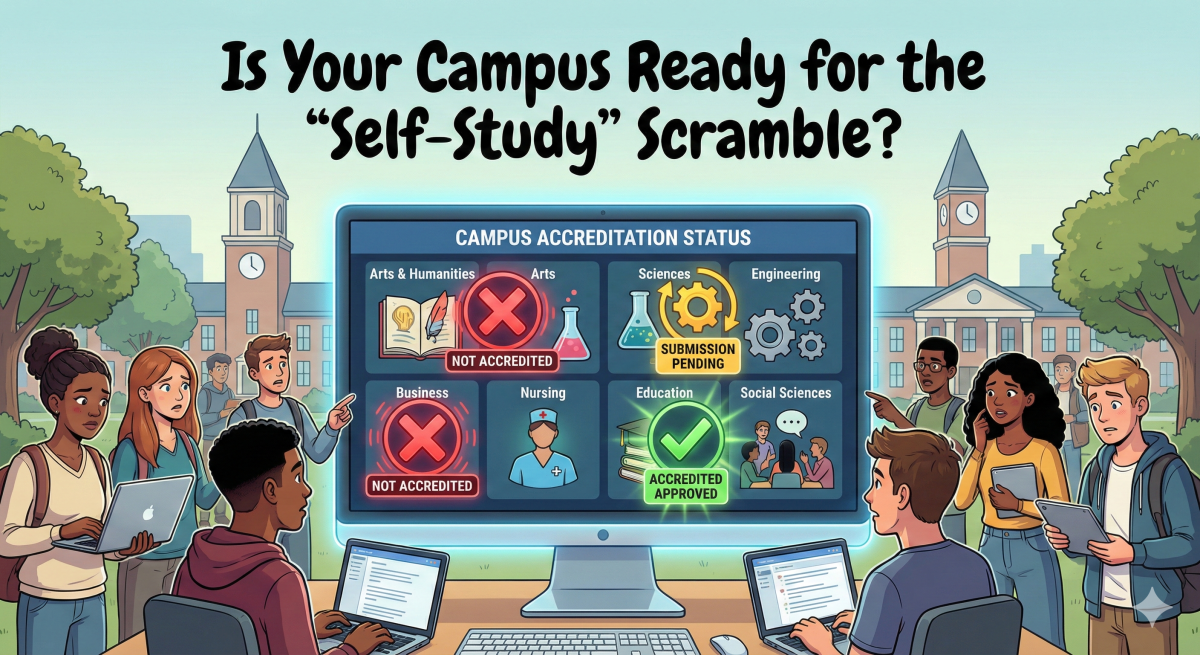
Is Your Campus Ready for the “Self-Study” Scramble? 

For many Institutional Effectiveness (IE) and Institutional Research (IR) teams, the word “accreditation” triggers a familiar sense of dread. It signals the start of the “Great Data Scramble”—a frantic, months-long process of emailing department heads, hunting down spreadsheets, and piecing together fragmented evidence to prove your institution is meeting its standards. 

While accreditation is meant to foster continuous improvement, the process of reporting often feels like a massive distraction. The sheer burden of data collection—pulling numbers from your Student Information System (SIS), Learning Management System (LMS), and financial software—can paralyze a team. 

If you are spending 80% of your time collecting data and only 20% analyzing it, the balance is wrong. It’s time to talk about why the old way of reporting is broken and how Unified Data offers a path out of the weeds. 

The Hidden Cost of the “Template Trap” 

The most common tool for accreditation reporting is still, unfortunately, the static spreadsheet. You likely have a folder full of “Common Data Set” templates or custom Excel files that you email to the Registrar, the Provost, and the CFO, hoping they fill them out correctly. 

While these templates provide a structure, they create three major burdens: 

The Version Control Nightmare 

We have all seen it: Enrollment_Data_Final_v3_ACTUAL.xlsx. When you rely on emailed templates, you aren’t managing data; you are managing files. Reconciling conflicting numbers from different stakeholders becomes a full-time job. 

The “Snapshot” Fallacy 

Accreditation bodies like HLC, SACSCOC, and NECHE increasingly demand evidence of continuous improvement. A static template captures a snapshot of your institution from six months ago. By the time the visiting team arrives, that data is stale, making it difficult to answer real-time questions about student success trends. 

Moving From “Collection” to “Connection” 

To lift the burden of accreditation, institutions need to stop asking “Who has this spreadsheet?” and start asking “How does our data flow?” 

The solution lies in Unified Data. Instead of manually harvesting data every ten years (or every reporting cycle), modern institutions are building “always-on” data lakes. When your data is unified, accreditation metrics—like retention rates, faculty credentials, and financial health ratios—are calculated automatically and continuously. 

How Datatelligent Automates the Evidence Room 

At Datatelligent, we believe that compliance shouldn’t come at the cost of your sanity. That’s why we built the Fusion Platform to automate the heavy lifting of higher ed data. 

Automate Ingestion with Fusion Flow 

The biggest bottleneck in accreditation is getting the data out of your siloed systems. Fusion Flow orchestrates the collection of data from every source—your SIS, CRM, LMS, and more—and automates the ingestion into a centralized Data Lake. No more manual exports; the data is simply there, ready for analysis. 

Visualizing Compliance with Fusion Vision 

Once your data is harmonized, Fusion Vision turns that raw information into intelligent insights. Imagine an “Accreditation Dashboard” that updates daily, allowing you to monitor your Key Performance Indicators (KPIs) year-round. When the self-study rolls around, you don’t need to scramble for evidence; you just point to the dashboard. 

Free Tools to Get Started 

We know that unified data is a journey. To help you benchmark your current standing, we offer resources like our Free IPEDS Comparison Tool. It’s a great example of how visualizing public data can save you hours of manual cross-referencing. 

Turn Compliance into Strategy 

Accreditation shouldn’t be a burden you survive; it should be an opportunity to thrive. By shifting from manual templates to a unified data platform, you can give your team the time they need to focus on what matters most: using that data to drive student success. 

Explore the Fusion Platform and see how we unify your data ecosystem. 

Categories
Blog

From Data Custodians to Strategic Partners: Solving the Data Wrangling Crisis in Institutional Research

If you ask Institutional Research (IR) or higher education analytics teams how they spend their time, the answer is often the same, just phrased differently:

  • “We’re constantly pulling data.”
  • “We spend more time cleaning than analyzing.”
  • “By the time the report is done, the question has already changed.”

This isn’t a skills problem. It’s not a motivation problem. And it’s certainly not because higher education lacks data.

It’s a Data Wrangling problem.

The Hidden Cost of Manual Data Wrangling

On most campuses, answering even a straightforward question requires a familiar sequence of manual data wrangling tasks:

  1. Pull data from multiple systems
  2. Normalize formats and definitions
  3. Reconcile inconsistencies
  4. Validate results
  5. Rebuild the same logic again next month

This work is necessary but it’s also repetitive, fragile, and time-consuming. It quietly consumes the time and attention of some of the most analytically capable people on campus.

The result is that highly trained Institutional Research professionals become data custodians, keeping systems running, reports updated, and requests fulfilled, rather than strategic partners helping leadership think ahead.

Why Weak Data Governance Stalls Strategic Planning

When data governance is an afterthought and preparation dominates the workflow, institutions fall into a reactive rhythm:

  • Reports are built on fixed schedules
  • Questions are answered after decisions are already in motion
  • Follow-up questions trigger another round of manual work

Even when leadership wants to plan more proactively, the reporting cycle becomes a constraint. Not because people aren’t asking the right questions, but because the governance frameworks aren’t in place to make data ready when they need it.

This creates a frustrating gap between what leaders want (insight, context, options) and what teams can deliver (static snapshots built after the fact).

Automating Data Flows to Empower Institutional Research

Reducing the data wrangling burden doesn’t start with better dashboards or more tools. It starts earlier, with how data moves.

When data flows are automated and backed by strong data governance standards:

  • Data arrives consistently, not manually
  • Logic is defined once, not recreated repeatedly
  • Updates happen continuously, not on request

This significantly shifts the role of Institutional Research teams. Instead of spending their time preparing data, they can spend it interpreting, contextualizing, and advising.

Moving from Descriptive to Prescriptive Analytics

That’s the difference between answering: “What happened last term?”

and helping leaders ask: “What’s changing, and what should we do next?”

The Real Outcome: Time for Student Success & Strategy

The most valuable outcome of reducing the data wrangling burden isn’t faster reports. It’s time.

Time to:

  • Explore trends instead of just summarizing them
  • Ask better questions
  • Connect data across enrollment, finance, and Student Success
  • Support planning rather than chasing deadlines

In an environment where institutions are being asked to do more with fewer resources, freeing up analytical capacity isn’t a luxury; it’s a necessity.

A Practical Path: Data Flows as the Foundation for Data Governance

Reducing the burden doesn’t require ripping out systems or rebuilding everything at once. On many campuses, the biggest gains come from improving how data flows between existing systems.

This is where the right infrastructure makes the difference. At Datatelligent, Data Flows play a foundational role in the Fusion Platform. By automating and standardizing extraction, transformation, and delivery, Data Flows help institutions enforce data governance while eliminating repetitive preparation.

When data flows are dependable, Institutional Research teams spend less time wrangling inputs and more time partnering with leaders on interpretation, planning, and decision-making. That shift, from preparation to perspective, is what enables analytics teams to operate strategically rather than reactively

Latest News
Days
Hours
Minutes