Higher education has never been short on data. What it has often been short on is the ability to use that data at the speed decisions actually need to be made.
That gap has never been more costly than it is right now. According to Inside Higher Ed’s 2025 survey findings, 50% of Chief Academic Officers report spending more of their time reacting to problems than planning for the future. Meanwhile, 82% of CFOs who expect their institution’s financial health to worsen point directly to uncertainty driven by federal policy and funding as the cause.
The challenge isn’t a lack of awareness. Leaders know what they need to know. The problem is that by the time the data arrives, the moment for action has often already passed.
The Static Report Trap
Most institutions still rely on reporting cycles built for a more predictable world: monthly enrollment snapshots, quarterly budget reviews, annual outcomes reports. These tools made sense when conditions were relatively stable, and decisions could wait.
That world no longer exists.
When federal funding shifts without warning, when enrollment trends break from projections mid-term, when a new state policy lands in the middle of budget planning, institutions need answers now, not at the end of the reporting cycle. Static reports weren’t designed for that kind of pressure. They describe what happened. They don’t help leaders respond to what’s happening.
The result is a familiar and frustrating pattern: by the time leadership has the data they need to act, the decision window has already narrowed or closed entirely.
What “Agile Data” Actually Means
Agile data isn’t a buzzword. It’s a practical shift in how institutions think about information and when it’s available.
An agile data environment is one where:
- Data is unified across systems, so enrollment, finance, and student success aren’t living in separate silos that have to be manually reconciled before anyone can answer a question.
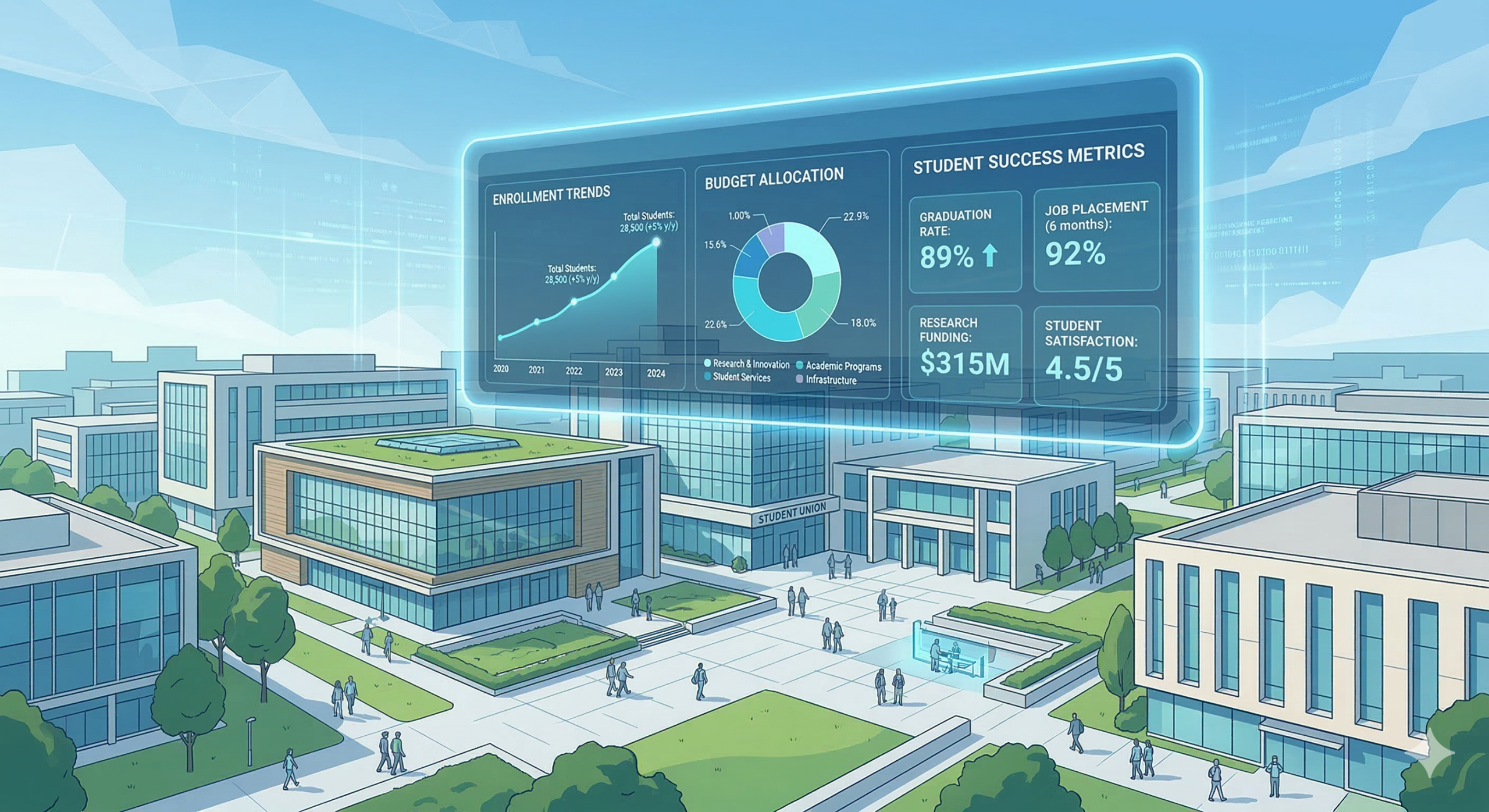
- Dashboards reflect near-real-time conditions, not last month’s snapshot.
- Leaders can stress-test scenarios against actual institutional data, rather than relying on projections built from incomplete or stale inputs.
- Follow-up questions don’t trigger another round of data preparation. The infrastructure is already in place to answer them.
The difference between a reactive institution and a proactive one often comes down to whether the data is ready when the question is asked.
From Reporting Cycles to Real-Time Strategy
Consider a common scenario: enrollment numbers begin to soften two weeks into a term. In a traditional reporting environment, that signal might not surface clearly until the end-of-term report is built and reviewed. By then, the options for intervention have narrowed considerably.
In an agile data environment, the same signal appears on a live dashboard. Leaders can see it, discuss it, and act on it while there is still time to make a meaningful difference, whether that means targeting outreach to specific student populations, adjusting course offerings, or reallocating support resources.
This is what it means to move from descriptive to prescriptive analytics. Not just knowing what happened, but being positioned to ask what to do next.
The Leadership Time Problem
The IHE findings also point to something else worth naming directly: leaders are stretched. Presidents report that the demands of the role can no longer realistically be handled by one person. CAOs cite burnout as a top driver of institutional turnover. Both groups are being asked to do more strategic work with less time and fewer resources.
Agile data helps solve that problem in a way that additional staff cannot. When dashboards surface the right information proactively, and when near-real-time visibility replaces manual report requests, leaders spend less time chasing numbers and more time making decisions. That shift, from data preparation to strategic thinking, is where the real return on investment lives.
Building the Foundation for Agile Data
Agile data doesn’t happen by accident. It requires a foundation, specifically a unified data environment where institutional systems are integrated, data flows are automated, and the logic behind every metric is consistent and trustworthy.
Without that foundation, even the best dashboard tools will underdeliver. Leaders will still find themselves waiting on data, debating whose numbers are right, and making decisions from an incomplete picture.
At Datatelligent, the Fusion Platform is built around this principle. By unifying data from across an institution’s key systems and delivering pre-built, higher-ed-specific analytic solutions, we help institutions stop having to rebuild reports from scratch every time a new question arises. The data is ready. The answers are accessible. And when conditions change, institutions can pivot without waiting for the next reporting cycle to catch up.
In a higher education environment defined by uncertainty, the ability to act on current, reliable data isn’t a competitive advantage. It’s a survival skill.